Most embroidery is priced in two parts: a one-time charge to set up the design, and a per-piece price for stitching it. The per-piece price usually comes from the stitch count at a rate per 1,000 stitches, with a minimum so small designs still pay, lower rates for bigger orders, and the garment itself on top.
Many shops use this method because stitch count tracks machine time. This guide walks through each part with example numbers you can swap for your own, and ends with a worked quote. To run the numbers on a real job, use the embroidery pricing calculator.
Common ways to price embroidery
| Method | How it works | Good for | Watch out for |
|---|---|---|---|
| Per 1,000 stitches | Stitch count × a rate per 1,000, with a minimum per piece | Most jobs; easy to explain and to scale | Needs a stitch count before you quote |
| Flat price by size | Set prices for size bands, such as a left chest logo up to a set stitch count | Simple price lists, websites and repeat customers | Dense designs inside a band can lose money |
| Per item | One price for a finished product, such as a towel with a name | Gifts, Etsy listings and personalized products | Must cover the largest design you allow |
| Hourly | Machine and labor time at an hourly rate | Unusual one-offs, repairs and samples | Customers find it hard to compare |
Many shops combine them: per-1,000-stitch pricing behind the scenes, published as simple size bands so customers can pick a price without knowing what a stitch count is.
Setting your rate per 1,000 stitches
A rate per 1,000 stitches is an hourly rate in disguise. Work it out from what an hour of machine time has to earn, not only from what other shops charge:
- Add up what the machine costs to run per hour: payments or depreciation, maintenance, needles, power and a share of rent.
- Add the hourly wage you want for running it.
- Estimate realistic stitches per hour, including hooping, trims, thread changes and breaks, not just top speed. A single-needle machine sewing at 700 stitches a minute rarely averages more than about 25,000–30,000 stitches an hour on real jobs.
- Divide the hourly target by stitches per hour and multiply by 1,000. That's your minimum rate.
For example, $30 an hour at 30,000 stitches an hour gives $1.00 per 1,000 stitches. Many shops land somewhere around $0.75–$1.50 per 1,000 on typical orders, with wholesale contract work often lower, but rates vary a lot by region, machine and order size, so treat that as a sanity check rather than a target. Before the design exists, estimate its stitches with the stitch count calculator.
Try it with your own design
Sign up free, upload an image and get a stitch preview in under a minute.
Drop your image here
PNG, JPG, WebP or SVG · stays on your device
Minimums and quantity breaks
A 2,000-stitch name at $1.00 per 1,000 comes to $2.00, which doesn't cover the time to hoop, thread and trim the piece. That's what a minimum per piece is for: charge whichever is higher, the stitch price or the minimum. Many shops also set an order minimum, such as 6 or 12 pieces, or add a small-order fee below it.
Quantity breaks share the savings of long runs. Once a design is set up and the machine is threaded, every extra piece is quicker. A simple break table, as an example:
| Quantity | Stitch rate | Example: 6,000-stitch logo |
|---|---|---|
| 1–11 | Full rate, $1.00 per 1,000 | $6.00 per piece |
| 12–23 | 10% off | $5.40 per piece |
| 24–47 | 15% off | $5.10 per piece |
| 48–99 | 20% off | $4.80 per piece |
| 100 and up | Quote each job | Depends on machine time |
Keep the breaks few and clear, and check that each one still covers your time.
Setup and digitizing fees
Turning a customer's logo into a stitch file is a one-time job, so charge for it once per design, not per piece. Many shops charge a setup or digitizing fee on the first order and waive it on reorders of the same design.
What you charge depends on what it costs you. A digitizing service often charges roughly $10–$50 or more for a typical logo and takes a day or more. Digitizing in-house on a subscription costs far less per design: on Embrizo's Shop plan, 100 designs a month come to $0.50 each billed monthly, or $0.20 billed yearly, if you use them all. The service comparison sets the options side by side, and the pricing page lists the plans.
- Artwork clean-up, when a logo arrives as a blurry screenshot and has to be redrawn. Run it through the embroidery image checker before you quote.
- Edits and resizes after the customer has approved a proof. A new size usually means digitizing again.
- Sample sew-outs for large orders, often credited back if the order goes ahead.
Blanks, thread and backing
If you supply the garments, the blank is often the biggest single cost in the quote, and it needs a markup. Ordering, receiving, counting and the occasional ruined piece all take time and money. Many shops add somewhere around 30–50% to the cost of the blank, often more on small orders and less on large ones.
- Thread, backing, needles and bobbins are small per piece. For a left chest logo they typically come to well under $0.50, but count them: on large, dense designs they add up.
- Spoilage. Plan for the odd bad hooping, thread break or flawed blank. A spare or two on larger orders is cheaper than a reorder.
- Customer-supplied items. Many shops charge more per piece when customers bring their own garments, since a ruined piece can't simply be replaced, and ask them to accept that risk in writing.
- Shipping and packaging, if you send orders out.
A worked example: 24 polos with a coffee shop logo
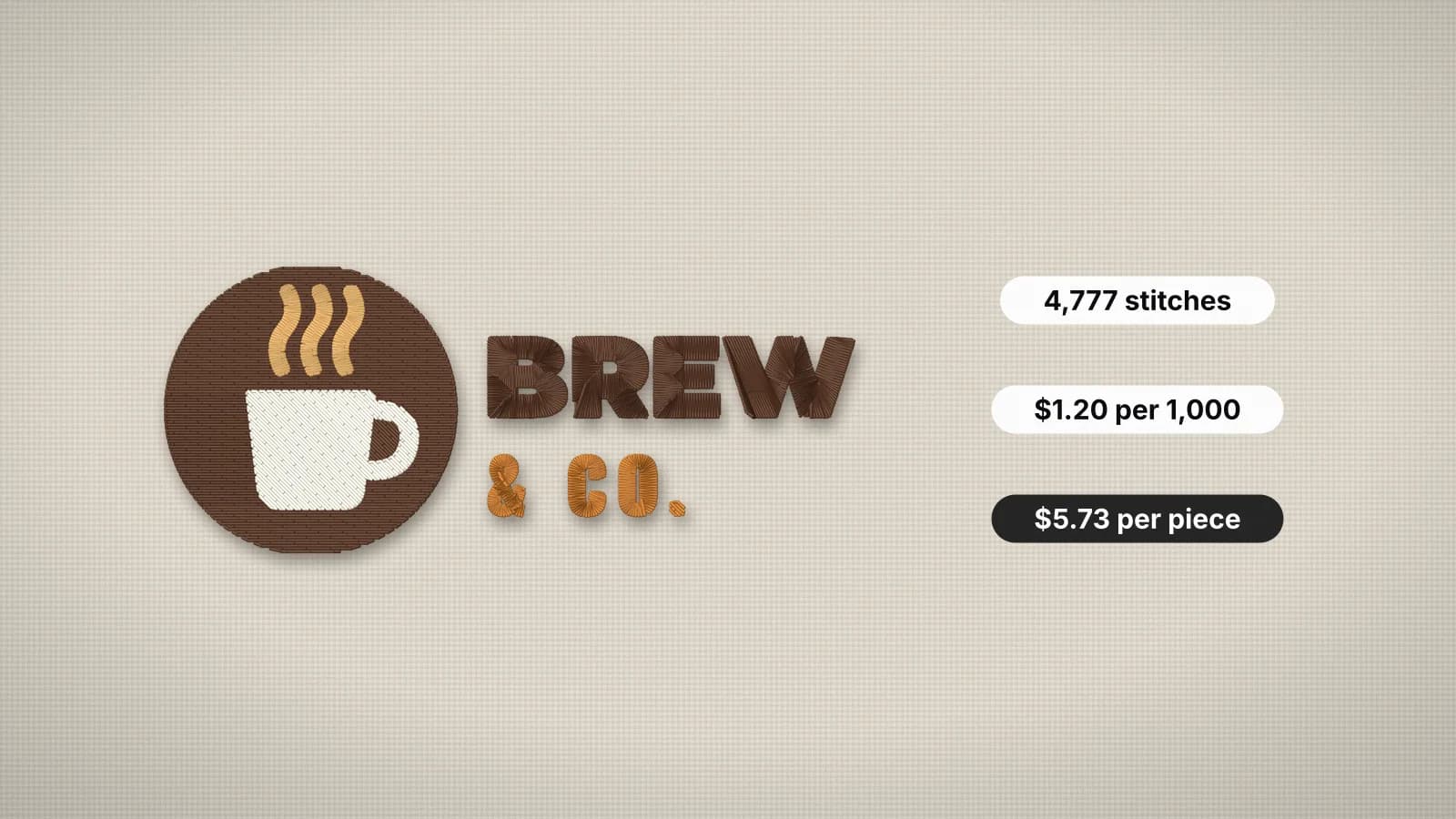
A coffee shop orders 24 polos with its logo on the left chest. The logo is 3.5 × 2.5 in (90 × 65 mm) in three colors, and the digitizer reports 6,000 stitches. Using the example rates above:
| Line | Calculation | Amount |
|---|---|---|
| Stitching | 6,000 stitches × $1.00 per 1,000 | $6.00 per piece |
| Quantity break | 24 pieces: 15% off the stitch charge | −$0.90 per piece |
| Blank polo | $12.00 cost + 40% markup | $16.80 per piece |
| Price per piece | $6.00 − $0.90 + $16.80 | $21.90 |
| Setup and digitizing | Once, for the new design | $25.00 |
| Order total | 24 × $21.90 + $25.00 | $550.60 |
Then check it against time. At 700 stitches a minute, 6,000 stitches take about 8.5 minutes; with hooping and two thread changes, call it about 12 minutes a piece on a single-needle machine, or about 5 hours for the order. The stitch charge of $5.10 × 24 is $122.40, about $25 an hour. If that's below your target, raise the rate or the minimum, or run the job on a faster multi-needle machine.
Quote from the real stitch count whenever you can. Upload the customer's artwork to the digitizer, read the stitch count and sew time, and price from those rather than guessing from the size.