Appliqué embroidery maker
Turn a shape, letters or your own silhouette into a ready-to-stitch appliqué file: placement line, tack-down and cover stitch as three color stops, with a cutting template at actual size.
Edge finish
Tack-down
Appliqué size
85 × 72 mm (3.3 × 2.8 in)
Cutting template
The fabric shape at actual size: print it, or cut it on a Cricut or Silhouette.
Color stop 1
Placement line
Hoop the garment with stabilizer and stitch the outline where the fabric goes.
Color stop 2
Tack-down
Lay the appliqué fabric over the outline and stitch it down, then trim the fabric close to the stitching.
Color stop 3
Cover stitch
The satin border covers the raw edge.
Appliqué · 3 color stops
- Stitches
- 1,813
- Colors
- 3
- Trims
- 3
- Width
- 87.8 mm
- Height
- 74.1 mm
- Sew time
- ~4 min
Thread colors
- 1111
- 2340
- 31,362
- What it does
- Shapes, Greek and varsity letters or a silhouette as appliqué: placement line, tack-down and satin border, plus a cutting template.
- Price
- Free preview; saving machine files needs a plan
- Works on
- Any browser: Windows, Mac, Chromebook, iPad and phones
- Privacy
- Runs in your browser; your images and files aren't uploaded
Three steps, one file
Shapes
Circle, heart, star, Christmas tree, oval, scallop, rounded square and square, sized in mm.
Letters
Varsity, block, rounded, serif, sport, script and Greek letters for sorority and team shirts.
Your silhouette
Upload clip art or a silhouette and its outline becomes the appliqué.
Edge finishes
Satin border, blanket stitch or raw-edge triple run.
Cutting template
An actual-size SVG for Cricut or Silhouette, or a printable template, mirrored for fusible web if you like.
Any machine
Save as PES, DST, JEF, EXP, VP3, XXX and more.
Appliqué that sews cleanly
- Keep satin borders 2.5–4 mm wide; wider borders need a heavier stabilizer.
- Trim the fabric close to the tack-down, within about 1 mm, so the satin covers it.
- Use curved appliqué scissors and keep the fabric in the hoop while you trim.
- Letters under about 25 mm tall are hard to trim: sew them as plain satin instead.
- Pre-wash cotton so the appliqué doesn't shrink and pucker later.
Free account
Start digitizing in under a minute
Create a free account to digitize any image, try every setting and watch it sew. Choose a plan only when you want to download files.
- Digitize and preview any image
- Realistic stitch preview and sew-out
- Download free ready-made designs
- No credit card needed

Questions
The quickest way to see what it does with your artwork is to try it. With a free account, digitizing and previewing cost nothing and take about a minute.
What is in an appliqué embroidery file?
Three color stops: a placement line that shows where the fabric goes, a tack-down that holds the fabric in place once it's laid over the line, and a cover stitch that finishes the raw edge, usually a satin border. The machine stops between them so you can place and trim the fabric.
How do I make appliqué letters for a sweatshirt?
Choose Letters, type up to eight characters or tap the Greek letters, pick a style and set the letter height, about 75–100 mm (3–4 in) for an adult sweatshirt front. Leave at least the satin width between letters so the borders don't run together.
How do I cut the appliqué fabric?
Download the cutting template: it's the fabric shape at actual size as an SVG for a Cricut or Silhouette, or print it and cut by hand. Tick Mirror for fusible web, since you trace on the paper backing. Or lay an oversized piece over the placement line and trim close to the tack-down in the hoop.
Satin, blanket or raw edge?
Satin gives the classic smooth border and hides the raw edge completely. Blanket stitch has a hand-sewn look for quilts and baby items. Raw edge sews a triple-run line inside the edge and lets the fabric fray softly after washing.
Which fabrics work for appliqué?
Tightly woven cotton, twill, felt, fleece, denim and glitter vinyl all work. Pre-wash cotton, back stretchy or thin fabric with fusible web, and use a cut-away stabilizer under knit garments like sweatshirts and tees.
Is the appliqué maker free?
Designing and previewing appliqué is free, and the cutting template comes with a free account. Saving the embroidery file needs a paid plan, from $8 a month billed annually.
More tools
Keep going
 GuideHow to digitize appliquéWhat an appliqué embroidery file contains, stitch settings for each step, trimming in the hoop vs pre-cutting with a template, making the file with Embrizo's appliqué maker, shapes and sizes that work, fabrics, and the common mistakes.Read the guide
 GuideHow to make appliqué letters for sweatshirtsWhat you need, letter sizes by garment, fonts that suit appliqué, letter fabrics, layering a letter on a contrasting backing, placing and hooping on a sweatshirt, and selling Greek letter and varsity sweatshirts.Read the guide
 GuideMachine appliqué embroidery: a step-by-step guideHow machine appliqué works step by step, which fabrics suit it, how appliqué files are built and how it differs from a stitched patch.Read the guide
 GuideHow to embroider a Christmas sweaterWhy knit sweaters are tricky, stabilizer and topping, hooping or floating, designs that work, appliqué trees, stockings and stars, sizes and placement, thread and needles, ready-made and custom Christmas designs, and finishing and washing.Read the guide
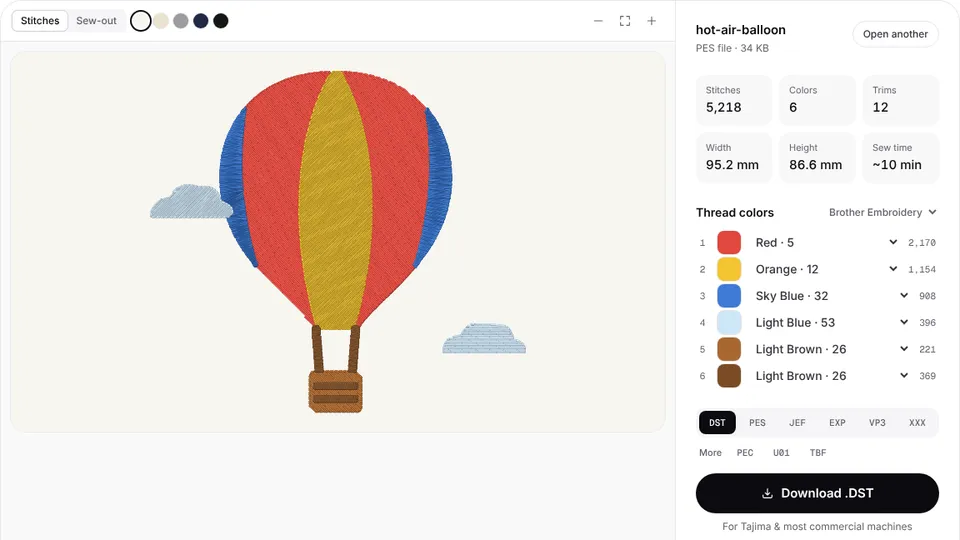 Free previewEmbroidery file converterConvert PES, DST, JEF, EXP, VP3 and XXX files to any other machine format.Open
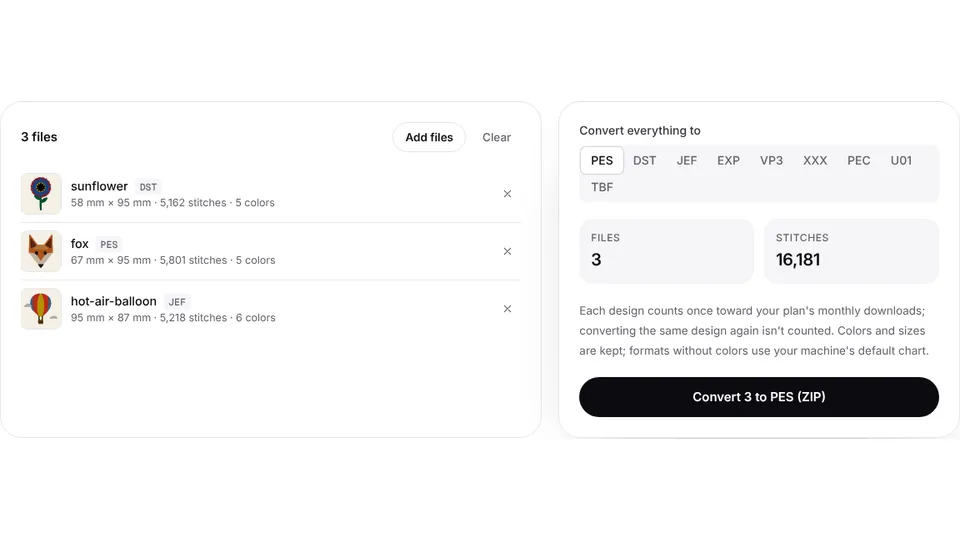 Free toolBatch embroidery file converterConvert up to 50 embroidery files to PES, DST, JEF or any format at once, as one ZIP.Open
Have a full-color design instead?
Digitize a logo, drawing or photo into fills and satin stitches in seconds.