Embroidery needle size chart
Pick your fabric and thread to get the right needle point and size, with a full chart of embroidery needle sizes and types from 60/8 to 100/16.
What are you embroidering?
Thread
Use this needle
75/11
Ballpoint embroidery
A rounded tip that slips between knit loops instead of cutting them, so knits don't run or hole.
- Knits run if the point cuts their loops, so a ballpoint is a must.
- The standard embroidery thread.
- Change the needle every 8–10 hours of stitching, or sooner if you hear a popping sound.
- What it does
- The right needle type and size for your fabric and thread, from 60/8 to 100/16.
- Price
- Free
- Works on
- Any browser: Windows, Mac, Chromebook, iPad and phones
- Privacy
- Runs in your browser; your images and files aren't uploaded
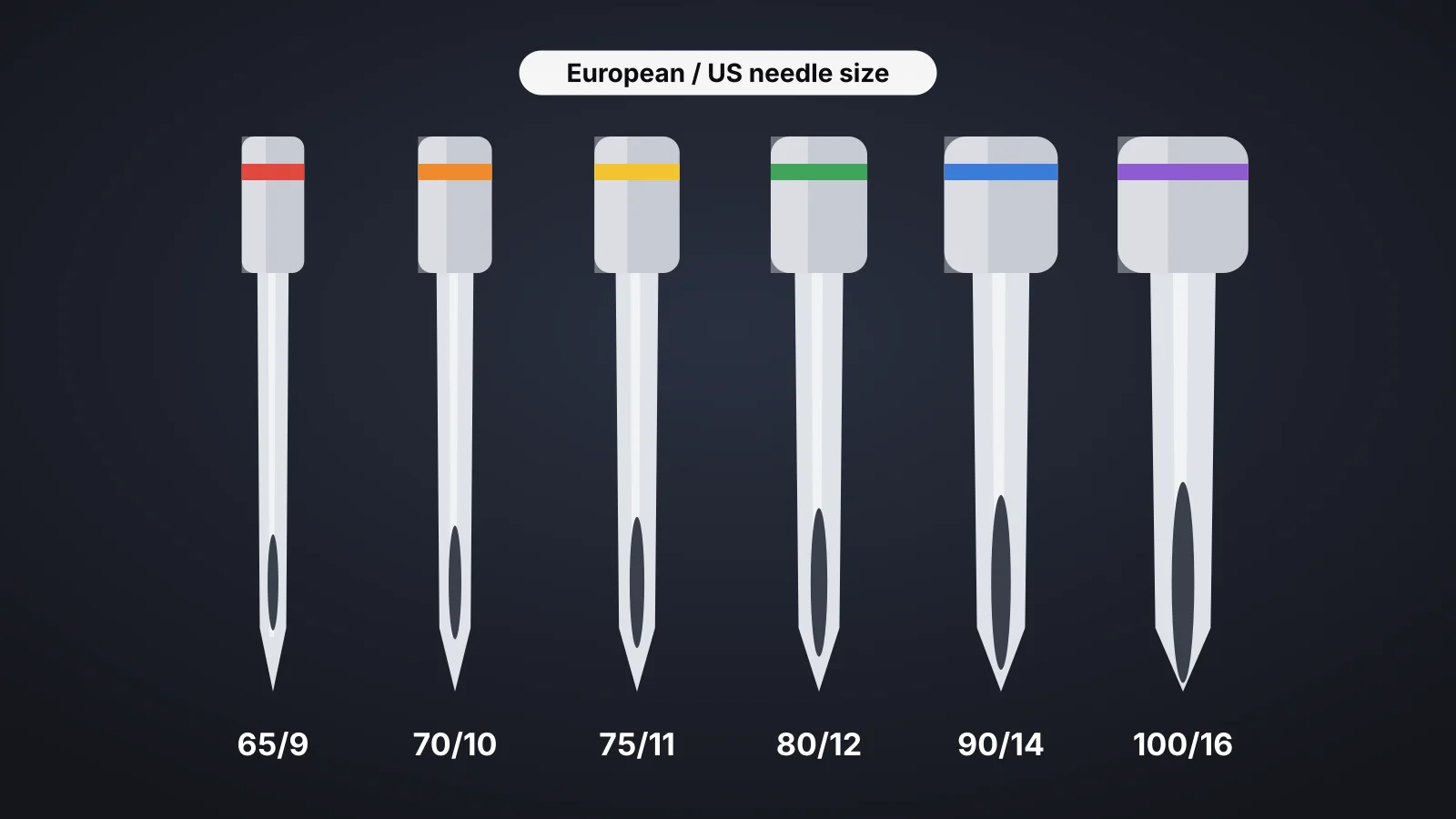
Embroidery needle size chart
| Size | Use it for |
|---|---|
| 60/8 | Very fine fabrics and 60 wt thread for tiny lettering |
| 65/9 | Silk, organza and fine batiste; 60 wt thread |
| 70/10 | Lightweight wovens, tulle and fine knits |
| 75/11 | The standard embroidery size: most fabrics with 40 wt thread |
| 80/12 | Medium-weight fabric, caps, towels and denim with 40 wt thread |
| 90/14 | Heavy canvas, denim and 30 wt or metallic thread |
| 100/16 | Very heavy fabric, thick leather and 12 wt thread |
The needle for each fabric (40 wt thread)
| Fabric | Needle | Why |
|---|---|---|
| T-shirts and polos | 75/11 Ballpoint embroidery | Knits run if the point cuts their loops, so a ballpoint is a must. |
| Sweatshirts and fleece | 75/11 Ballpoint embroidery | A ballpoint keeps the knit backing intact; use a water-soluble topping on the pile. |
| Performance and stretch | 70/10 Ballpoint embroidery | Fine, slippery knits need a small ballpoint to avoid pulled threads and holes. |
| Woven cotton and quilting | 75/11 Sharp embroidery | A sharp point gives the cleanest stitches on stable woven cotton. |
| Denim and canvas | 80/12 Sharp embroidery | Dense weaves need a stronger sharp point, a size or two up. |
| Structured caps | 80/12 Titanium-coated sharp | Buckram and seams dull needles fast; titanium stays sharp and runs cooler. |
| Towels (terry) | 80/12 Sharp embroidery | Pierce the base weave cleanly; a topping keeps stitches above the loops. |
| Leather | 80/12 Leather (wedge point) | Wedge points cut leather cleanly. Lower the density and avoid tiny stitches. |
| Faux leather and vinyl | 75/11 Titanium-coated sharp | A sharp titanium needle pierces vinyl without tearing it or picking up residue. |
| Silk and satin | 65/9 Sharp embroidery | The finest sharp needle leaves the smallest holes in delicate weaves. |
| Tulle, organza and mesh | 65/9 Sharp embroidery | A small sharp needle with water-soluble stabilizer keeps sheer fabric from tearing. |
| Felt | 75/11 Sharp embroidery | A standard sharp needle; felt is stable and forgiving. |
Ballpoint, sharp, titanium and more
| Type | What it's for |
|---|---|
| Ballpoint embroidery | A rounded tip that slips between knit loops instead of cutting them, so knits don't run or hole. |
| Sharp embroidery | A fine sharp point that pierces woven threads cleanly for crisp, accurate stitches. |
| Titanium-coated sharp | Stays sharp up to several times longer and resists adhesive build-up: caps, stabilizer sprays and long runs. |
| Metallic | A long eye and wide groove that stop metallic thread from fraying and shredding. |
| Leather (wedge point) | A cutting point that slices clean holes in real leather. Use few, well-spaced stitches. |
| Topstitch | An extra-large eye for heavy 30 wt and 12 wt threads. |
Fewer breaks and cleaner stitches
- Insert the needle all the way up with the flat side facing the back (on most home machines).
- A bent or dull needle causes skipped stitches, loops and bird nests; replace it rather than adjusting tension.
- Wipe adhesive spray residue off the needle, or switch to titanium when you use spray stabilizer.
- Match needle size to the thread: the thread should sit in the groove on the front of the needle.
Free account
Start digitizing in under a minute
Create a free account to digitize any image, try every setting and watch it sew. Choose a plan only when you want to download files.
- Digitize and preview any image
- Realistic stitch preview and sew-out
- Download free ready-made designs
- No credit card needed


Questions
The quickest way to see what it does with your artwork is to try it. With a free account, digitizing and previewing cost nothing and take about a minute.
What size needle is best for machine embroidery?
A 75/11 embroidery needle suits most machine embroidery with standard 40 wt thread. Go down to 65/9 or 70/10 for fine fabrics and 60 wt thread, and up to 80/12 or 90/14 for denim, canvas, caps and heavier or metallic thread.
Ballpoint or sharp needle for embroidery?
Ballpoint for knits such as T-shirts, polos, sweatshirts and performance wear, so the point slips between the loops instead of cutting them. Sharp for wovens such as cotton, denim, canvas, towels and caps, where a clean pierce gives crisp stitches.
What do the two numbers on a needle mean?
They're the same size in two systems: the European metric size (the shaft diameter in hundredths of a millimeter, so 75 is 0.75 mm) and the US size. 75/11 and 90/14 are the same needles called by both names.
Can I use a regular sewing needle for embroidery?
It works in a pinch, but embroidery needles have a larger eye and a special groove that protect the thread during thousands of fast stitches. A regular needle shreds and breaks thread more often.
How often should I change my embroidery needle?
About every 8–10 hours of stitching, at the start of each big project, or right away if you hear a popping sound, see skipped stitches or the thread starts to fray. Titanium needles last several times longer.
Which needle for metallic thread?
A metallic needle, size 80/12 or 90/14. Its long eye and wide groove stop the metallic foil from stripping. Slow the machine down and loosen the top tension as well.
More tools
Keep going
 GuideMachine embroidery needle guide: sizes and typesNeedle sizes from 65/9 to 90/14, ballpoint, sharp and titanium points, which needle each fabric and thread needs, and when to fit a new one.Read the guide
 GuideWhy does my embroidery needle keep breaking?Causes at a glance, hoop and frame strikes, choosing the needle size and type, thick seams and deflection, dense and stacked stitches, bent and badly inserted needles, and when the machine needs a service.Read the guide
 GuideWhy embroidery thread keeps breakingA cause-and-fix table for thread that breaks or shreds, the order to check things in, and what to do about needles, threading, thread quality, tension, burrs, speed and designs that are too dense.Read the guide
 GuideEmbroidery stabilizer guide: which backing for which fabricThe stabilizer types, which one each fabric needs and how to hoop for a flat, pucker-free result.Read the guide
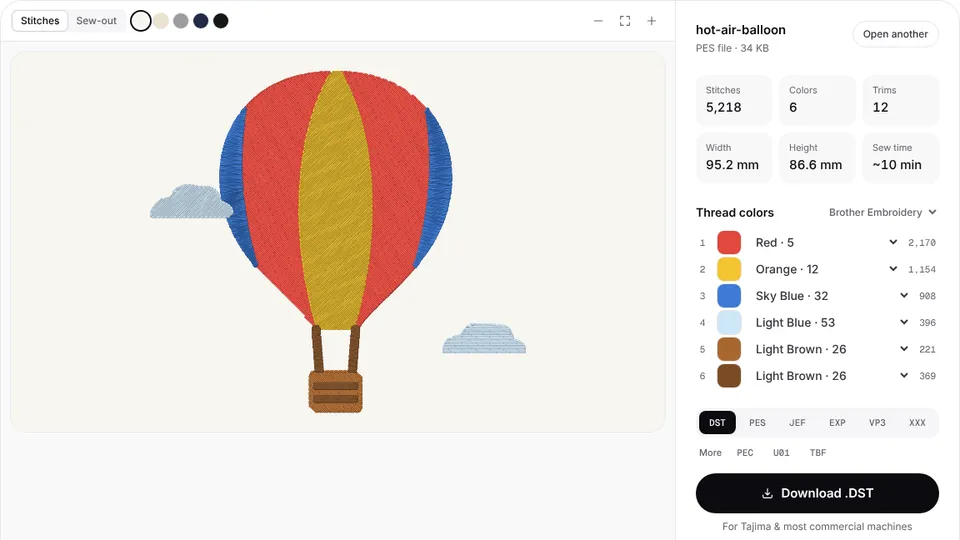 Free previewEmbroidery file converterConvert PES, DST, JEF, EXP, VP3 and XXX files to any other machine format.Open
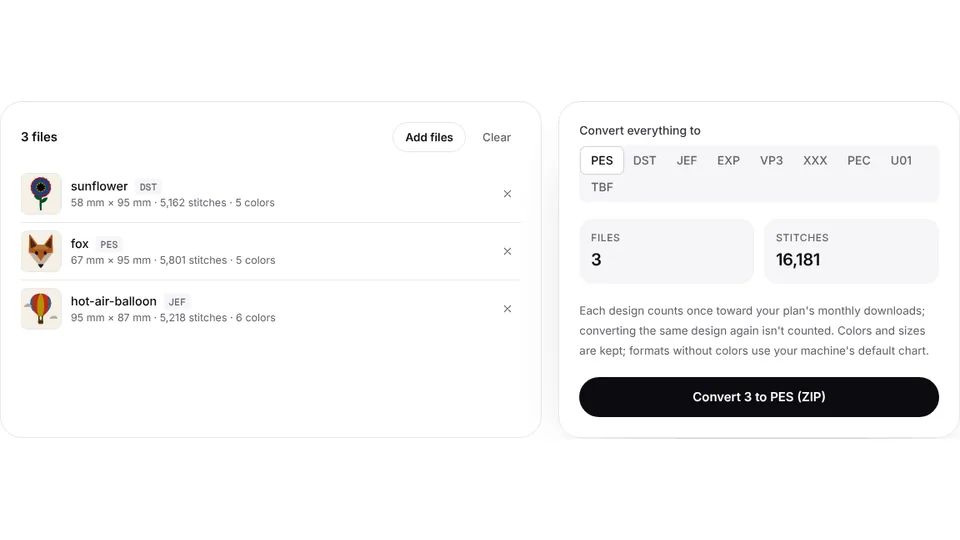 Free toolBatch embroidery file converterConvert up to 50 embroidery files to PES, DST, JEF or any format at once, as one ZIP.Open
Needle ready? Now the design
Turn a logo or drawing into a stitch file with the right density for your fabric.