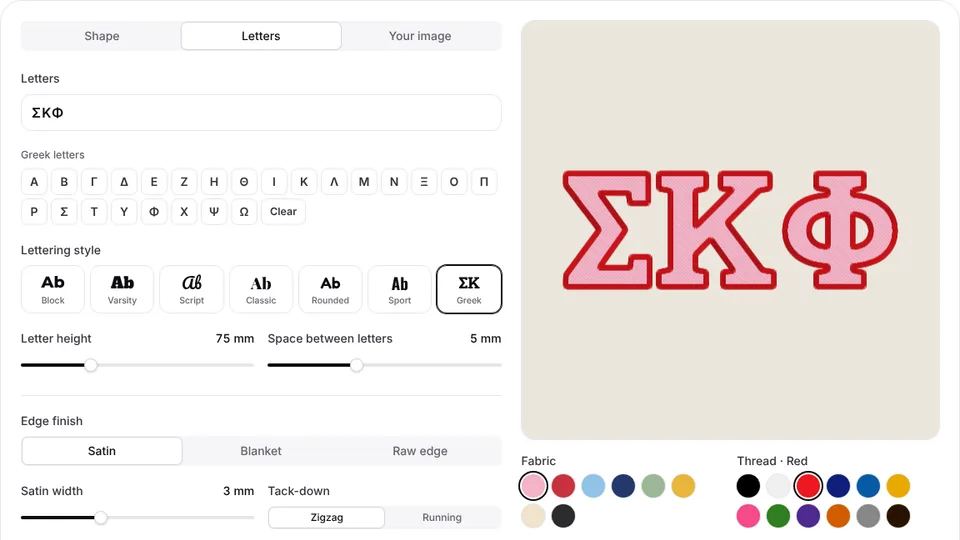
 Free previewAppliqué makerShapes, Greek and varsity letters or a silhouette as appliqué: placement line, tack-down and satin border, plus a cutting template.Open the tool
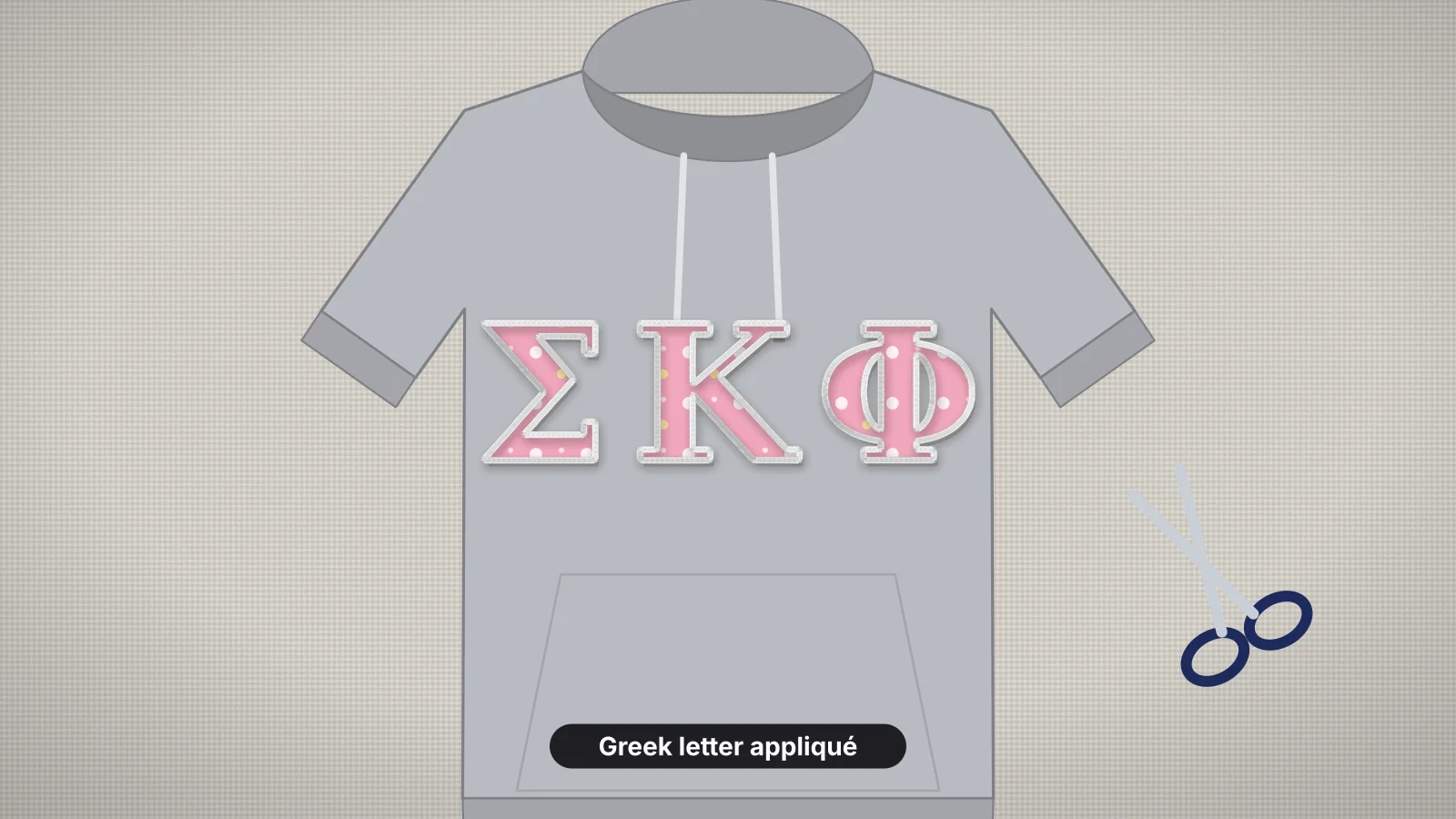
Greek letter sweatshirts, varsity initials and name crewnecks all use the same technique: letters cut from fabric and stitched down with a satin edge. They look bolder than stitched lettering, feel softer on the chest and sew in a fraction of the stitches, which makes them a favorite for sororities, fraternities, teams and custom gifts.
This guide covers letter sizes for each garment, fabric choices, layered letters on a contrasting backing, placement, hooping a sweatshirt and selling the finished pieces. The how to digitize appliqué guide explains the stitch file itself.
What you need
- An appliqué letter file with a placement line, tack-down and satin cover for each letter. Embrizo's appliqué maker makes one in Letters mode from up to a few typed characters, which covers Greek letter sets, initials and short names.
- Letter fabric: tackle twill, felt, glitter vinyl or a cotton print, with fusible web for anything that frays.
- A blank: a cotton or cotton-poly sweatshirt, hoodie or crewneck. Heavier blanks hold the letters flatter.
- Backing: a medium cut-away or no-show mesh for the knit, plus temporary spray adhesive or tape.
- Tools: curved appliqué scissors, a printed placement template, a ruler and a marking pen that washes or brushes off.
- Thread: 40 wt polyester for the satin, in a color that frames the letter fabric.
Letter sizes by garment
| Garment and placement | Letter height | Notes |
|---|---|---|
| Adult sweatshirt, across the chest | 75–100 mm (3–4 in) | The classic Greek letter look; three letters usually run about 190–270 mm (7.5–10.5 in) wide, depending on the letters and spacing |
| Adult hoodie, above the pocket | 65–90 mm (2.5–3.5 in) | Keep the bottom of the letters above the pocket seam |
| Youth sweatshirt | 50–75 mm (2–3 in) | Scale the gaps down with the letters |
| Varsity initial, chest | 100–150 mm (4–6 in) | Usually one letter, often layered on a contrasting backing |
| Baby bodysuit or toddler tee | 50–75 mm (2–3 in) | One bold initial reads better than a long name at this size |
| Tote bag | 75–125 mm (3–5 in) | Canvas holds letters flat and suits big initials |
| Sleeve | 25–40 mm (1–1.5 in) | Near the lower limit for appliqué: choose a very bold font, or stitch these as filled lettering |
Below about 25 mm (1 in), the satin border takes up most of each stroke and trimming gets fiddly. Keep every stroke of the letter at least about 8–10 mm (0.3–0.4 in) wide so fabric shows between the satin edges. The lettering size calculator shows how tall letters come out at a given width, and the center chest size guide covers that placement.
Try it with your own design
Sign up free, upload an image and get a stitch preview in under a minute.
Drop your image here
PNG, JPG, SVG, PDF or AI · stays on your device
Not sure what to expect? See real examples or how it works.
Fonts that suit appliqué letters
- Block and varsity fonts with thick, even strokes are the easiest to cut and edge. Slab serifs and collegiate styles give the classic varsity look.
- Greek letters are mostly straight strokes, which makes them some of the easiest appliqué shapes. Watch the sharp points on Sigma, Delta and Lambda: round them slightly or let the satin miter neatly.
- Script and thin fonts don't suit appliqué, because the thin parts end up all satin. Stitch them as lettering instead with text to embroidery.
- Counters, the holes in A, B, O, P and R, are small at 75 mm (3 in). Pre-cutting the letters makes them far easier than trimming them in the hoop.
- Spacing. Leave about 10–15 mm (0.4–0.6 in) between letters on a sweatshirt front, so the satin borders don't touch and each letter reads on its own.
Fabric choices for letters
| Fabric | Look | Tips |
|---|---|---|
| Tackle twill | Classic varsity and athletic | Comes plain or with a heat-seal backing you can press in place before stitching; barely frays |
| Felt | Soft, matte and retro | Wool-blend felt washes better than craft felt; it doesn't fray, so it's forgiving to cut |
| Glitter vinyl or glitter canvas | Sparkly, popular for bid day and game day | Needle holes are permanent: pre-cut it, tape it rather than pin it and use a single tack-down |
| Cotton prints | Florals, plaids and pattern mixes | Back with fusible web; prints make each sweatshirt one of a kind |
| Corduroy, sherpa and velvet | Textured and cozy | Thicker: use a zigzag tack-down, a water-soluble topping on pile and an 80/12 or 90/14 needle |
Prewash cottons that will be washed on a garment, so the letters don't pucker after the first wash. Match the satin thread to the backing or the sweatshirt for a crisp, framed edge, or to the letter fabric for a softer look.
Layering a letter on a contrasting backing
Layered letters, such as a floral print on a solid twill backing, are the signature Greek letter style. The backing shows as an even border around the top letter, often about 3–6 mm (1/8–1/4 in).
| Method | How it works | Good for |
|---|---|---|
| Both layers in one file | Placement, tack-down and trim for the backing letter, then the same for the top letter, then the satin covers | Repeat orders where every letter needs a stitched edge |
| Fused backing | Cut the backing letter with an offset, fuse it in place, then stitch the top letter's appliqué file over it | Quick layered sets with any one-layer appliqué file |
- For a fused backing, add an offset of 3–6 mm around the letter outline in a cutting machine's offset tool or a vector editor, and cut it from felt or heat-seal twill.
- Use the placement template to center the backing letters, then fuse them with a press or iron.
- Hoop the sweatshirt and stitch each top letter centered on its backing: placement line, tack-down, trim, satin cover.
- Edge a backing that frays with a narrow zigzag or a running stitch about 2 mm in from its edge.
Cotton backings fray in the wash, so give them a stitched edge. Felt and heat-seal twill hold up better fused on their own, but a stitched edge always lasts longest.
Placing letters on a sweatshirt
- Find the center. Fold the sweatshirt in half lengthwise and press a light crease, or measure between the side seams.
- Set the height. On adults, the top of the letters usually sits about 75–100 mm (3–4 in) below the bottom of the collar ribbing, a little less on youth sizes.
- Print a placement template. The placement template prints the design at true size with cross hairs, so you can lay it on the sweatshirt and mark the center.
- Check it on a body. Letters that look centered flat on a table often sit low once worn. Hold the template up to the wearer or a dress form before you hoop.
The placement guide covers the standard positions for chest, back, sleeves and hoods.
Hooping a sweatshirt for appliqué
- Use cut-away backing. Sweatshirt knit stretches and a satin border is dense, so tear-away isn't enough to stop puckering. The hoodie stabilizer page has the details.
- Hoop from the hem. Slide the hoop up inside the sweatshirt from the bottom, so the back and sleeves stay clear of the needle.
- Or float it. Hoop sticky stabilizer, or cut-away sprayed with temporary adhesive, and press the sweatshirt onto it. Floating avoids hoop burn on fleece.
- Keep it flat, not stretched. Knit pulled tight in the hoop relaxes afterward and puckers around the letters.
- Check the hoop size. Three 100 mm (4 in) letters can run past 250 mm (10 in) wide, which needs a large hoop such as an 8 x 12 in (200 x 300 mm) with the design turned. With a smaller hoop, stitch the letters one or two at a time and line each hooping up with the placement template.
- Trim off the machine, in the hoop. Take the hoop off the machine to trim, but leave the sweatshirt hooped so the satin lines up with the edge.
The sweatshirt guide covers needles, thread and washing.
Practice on a free design
167 ready-to-sew designs in every machine format, free with an account.



Selling appliqué letter sweatshirts
- Offer set choices. Customers pick the letters, a letter fabric, a backing color and a thread color. A short list of fabrics you stock keeps orders simple.
- Price the time, not just the stitches. Appliqué uses fewer stitches than filled letters, but cutting and trimming take time. Count both, plus the blank. The pricing calculator and how to price embroidery cover the math.
- Batch the cutting. For a chapter or team order, pre-cutting letters with a template or a cutting machine is much faster than trimming each one in the hoop.
- Show the options. The hoop mockup makes listing images from the design, and photos of finished pieces sell best. See how to sell embroidery on Etsy.
- Check what's licensed. Many Greek organizations, schools and teams license their names, crests and symbols, and some treat their letters as a licensed mark too. Check before you sell; the copyright guide covers the basics.