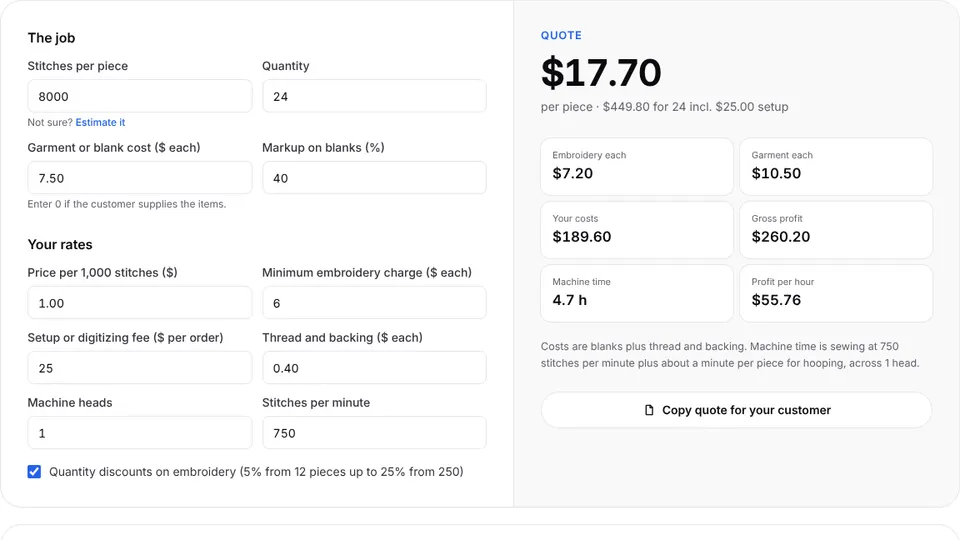
 Free toolEmbroidery pricing calculatorQuote embroidery jobs: per-1,000-stitch rates, blanks, setup fees, quantity breaks and profit.Open the tool
Custom hats are one of the best products for a small embroidery business: the blanks are cheap, the logo is small, almost every business and team wants them, and they reorder. Hats are also one of the hardest things to embroider well, so the machine and the file matter more than on a T-shirt.
This guide covers machines and cap frames, blank caps and where to buy them, pricing per hat with worked numbers, digitizing for caps, production time and where to find customers. It builds on the hat embroidery guide, which covers stabilizer and hooping, and the general guide to starting an embroidery business.
What machine do you need to embroider hats?
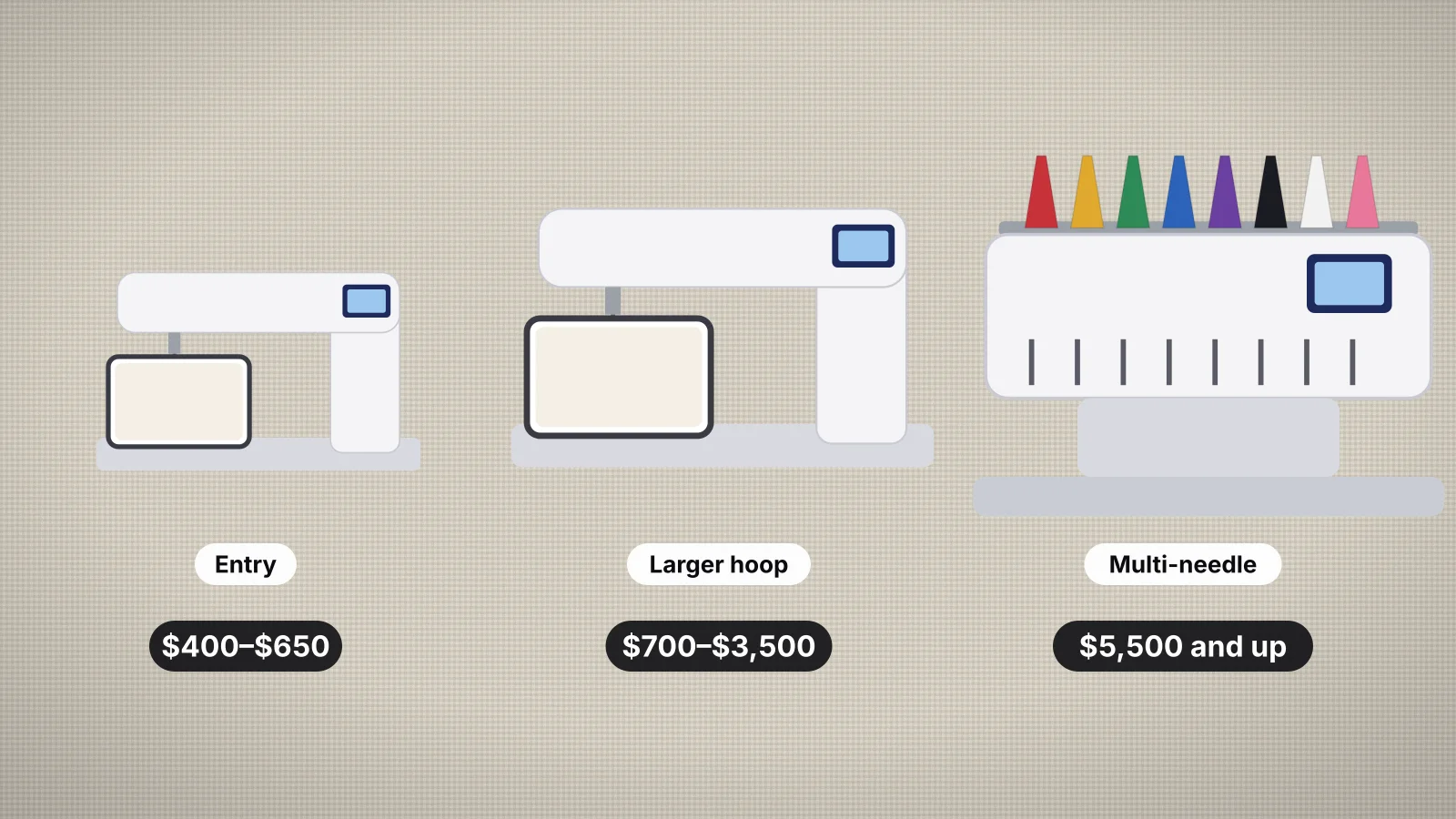
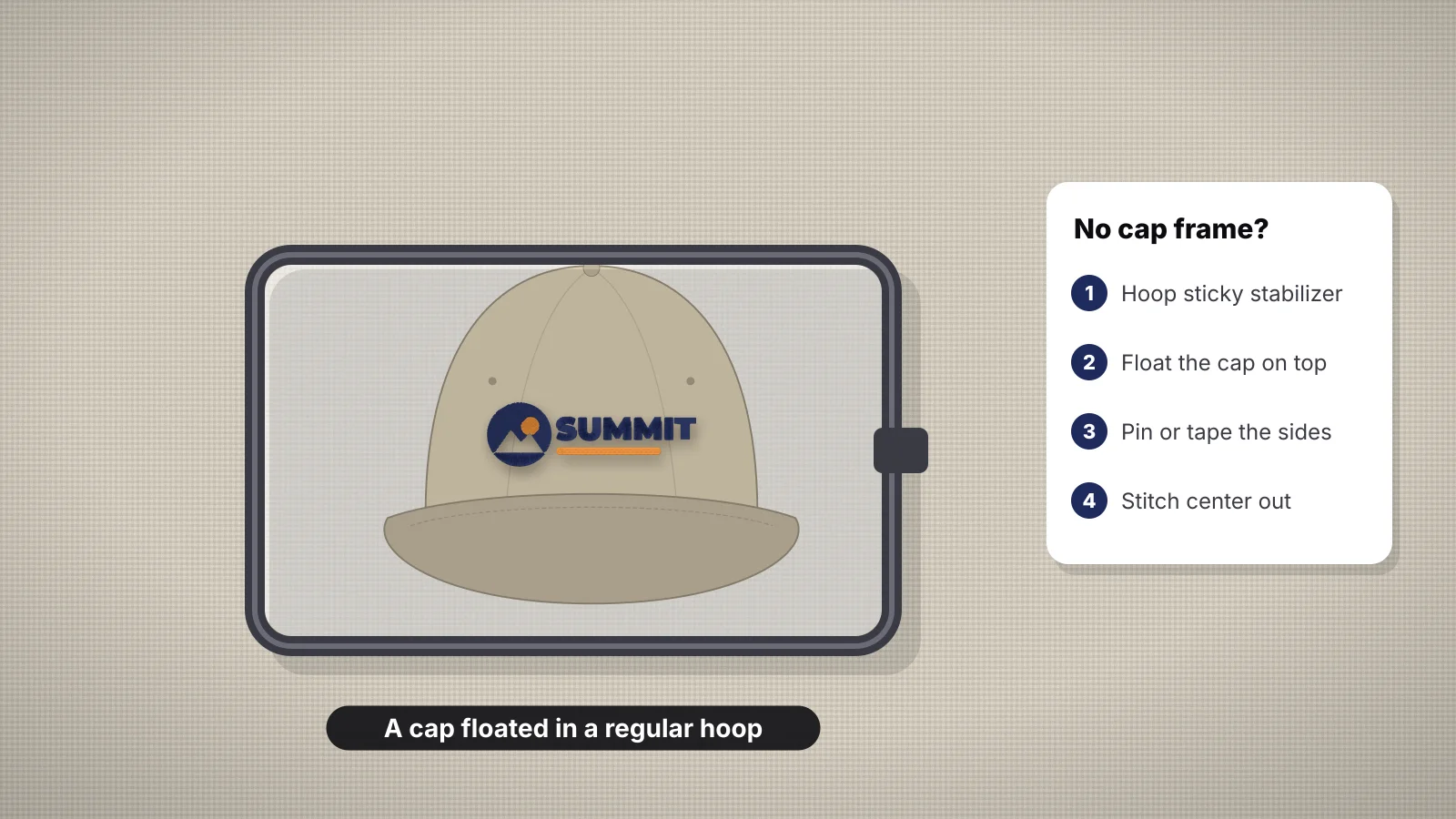
Structured caps need a cap frame and a cap driver, which in practice means a multi-needle machine or one of the few single-needle machines that take a cap frame. A flat single-needle home machine can only do unstructured caps hooped flat, or patches that are sewn or pressed on afterwards.
| Machine | How it holds caps | Typical price | Good for |
|---|---|---|---|
| Flat single-needle home machine | Unstructured caps hooped flat or floated on sticky stabilizer; no structured caps | About $400–$1,500 | Testing the idea, dad hats and patch hats |
| Single-needle with a cap frame, such as the Brother PRS100 | An optional cap frame on a free arm; Brother's PRCF3 cap frame sews about 130 × 60 mm | Ask a dealer | Small runs of structured caps |
| Home multi-needle, 6–10 needles | A cap driver and frames: the Ricoma EM-1010 ships with 2 cap rings and a cap driver, and some Brother PR680W bundles include a cap frame set | About $5,500–$13,000 | A side business with regular hat orders |
| Commercial single-head, often 12–20 needles | Wide-angle cap frames that sew across the front and onto the sides, such as 75 × 360 mm on the Tajima TMBP2-SC and 14.1 × 3.25 in on the Melco SUMMIT | From about $11,400 for a Ricoma MT-1501 | Full-time hat shops, side and back logos |
| Multi-head | Two or more heads sewing identical caps at once | About $14,200 for 2 Ricoma heads, more for larger machines | High volume |
Check three things before you buy: whether the cap driver and frames are included or extra, the cap sewing area, and the top speed on caps, which makers list below the flat speed, such as 650 stitches a minute on the Happy HCH-701 Journey and 1,200 on the Melco SUMMIT. How much an embroidery machine costs has 2026 prices, and the multi-needle machine list compares fields and needles.
A second or third cap frame is the cheapest speed upgrade. You hoop the next cap while the machine sews, which saves a minute or two on every hat.
Which blank caps should you buy, and where?
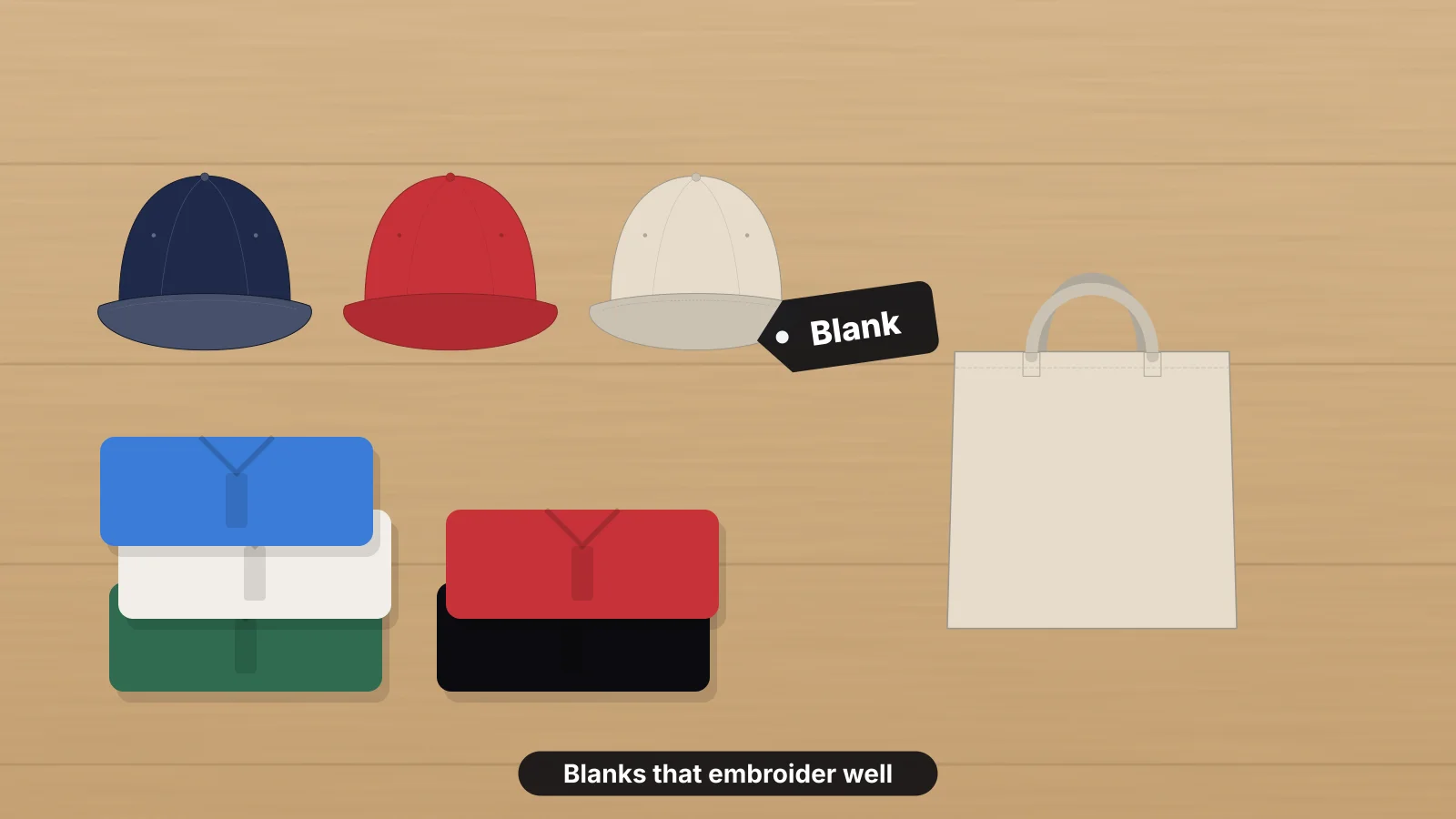
Start with three or four proven styles, usually a structured six-panel, a trucker, an unstructured dad hat and a beanie for winter, from cap brands such as Richardson, Flexfit and Yupoong, Otto Cap and Port Authority. Blank caps typically cost about $4–$12 each.
| Style | Examples | What to know |
|---|---|---|
| Trucker | Richardson 112, Yupoong 6606 | The most requested cap. Mesh back, so stitch only the front panels |
| Structured six-panel | Snapbacks and fitted caps from Flexfit and Yupoong | Holds a logo well; mind the center seam |
| Unstructured dad hat | Yupoong 6245CM | Easy to hoop flat; needs firmer backing |
| Five-panel | Several makers | One seamless front panel, the easiest front to stitch |
| Beanie | Cuffed knit beanies | A winter add-on stitched on the cuff; see how to embroider a beanie |
| Supplier type | Examples | Pros and cons |
|---|---|---|
| Wholesale apparel distributors | SanMar, S&S Activewear | The lowest prices and fast shipping, but you need a business account; a state resale certificate lets you buy without paying sales tax |
| Online blank-cap sellers | Joe's USA and other online blank shops | Easy to start with small quantities; usually a little more per cap |
| Retail and marketplaces | Amazon and big-box stores | Fine for a sample; the most expensive and least consistent source for orders |
Public listings in November 2026 put a single Richardson 112 at about $7–$10 from some blank-hat sellers, with lower prices by the case. Keep one cap style and color per order where you can, and buy one or two spares per style for test sew-outs: caps from different makers sit differently in the cap frame.
Try it with your own design
Sign up free, upload an image and get a stitch preview in under a minute.
Drop your image here
PNG, JPG, SVG, PDF or AI · stays on your device
Not sure what to expect? See real examples or how it works.
How much should you charge per hat?
Charge the blank marked up about 30–50 percent plus a stitching charge of about $6–$8 a cap, which comes to about $13–$26 per hat for one or two pieces with a front logo. Local shops and online decorators typically charge about $15–$35 a hat in small orders, and one large online decorator lists about $17–$23 a hat at 24 to 100 hats.
| Quantity | Stitching per cap | With an $8 cap marked up 40% |
|---|---|---|
| 1 | $7.50 | $18.70 |
| 12 | $7.20 | $18.40 |
| 24 | $6.60 | $17.80 |
| 48 | $6.30 | $17.50 |
| 100 | $6.00 | $17.20 |
| 250 | $5.70 | $16.90 |
The stitching column comes from the same model as the embroidery price chart: about $1 per 1,000 stitches with a $6 minimum, plus about $1.50 a cap for the slower cap frame, with quantity breaks from 12 pieces. Add separate charges for a back or side logo, 3D puff and rush orders, and a one-time digitizing or setup fee for each new logo; digitizing services often charge about $10–$50 a design.
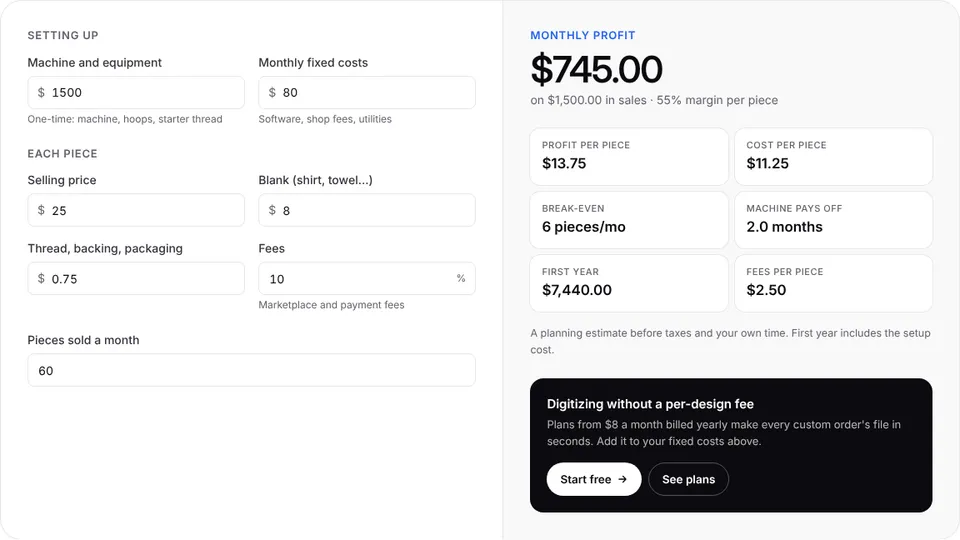
A worked order: 24 Richardson 112 caps with a 4,600-stitch front logo at $17.80 each is $427.20. The caps cost about $192 and thread and backing about $10, which leaves about $225 for roughly 3.5 hours of hooping and sewing, or about $65 an hour before rent, machine payments and other costs. The embroidery pricing calculator builds a quote like this from your own rates, and the embroidery business calculator shows profit per month and how fast a machine pays for itself.
How do you digitize a logo for caps?
Make the cap file wide and short, at most about 2–2.25 in (50–57 mm) tall and 4–5 in (100–125 mm) wide, sewn from the center out and from the bottom up, with bold lettering at least 6–7 mm tall. A file made for a shirt usually needs changes before it sews well on a cap.
- Size for the cap and the frame. Structured caps take about 2–2.25 in of height, unstructured and low-profile caps about 1.75–2 in. Check the frame's field too: a design that fits the cap can still be too wide for a small frame such as Brother's 130 × 60 mm PRCF3.
- Sew from the center out and the bottom up. Every stitch pushes the fabric. Starting in the middle and near the brim pushes it toward the sides and the crown, where it can move, instead of trapping a bubble in the center.
- Mind the center seam. On six-panel caps the seam is a ridge under the needle. Fills and wide satin cross it well; small letters and hairlines on the seam look broken.
- Go bold. Drop taglines, keep to 2–4 colors and avoid very dense fills, which stiffen the front and can pucker around the logo.
- Use cap backing. A tear-away made for caps suits structured caps; the cap stabilizer page covers the rest.
- Specialty work needs specialty files. 3D puff, popular on caps, needs a file made for foam; see 3D puff embroidery.
The cap front size page shows the area, and the hat logo embroidery file page sizes a logo for it. If a customer's logo is detailed, designing a logo for embroidery shows how to make a simpler embroidery version, and patch hats are a good answer for logos that won't simplify.
How long does it take to make custom hats?
About 8–10 minutes a hat on one head for a typical 4,600-stitch front logo: roughly 6–7 minutes of sewing at 700 stitches a minute, plus a minute or two to hoop and load the cap. That's about 50–60 caps in an 8-hour day.
| Order | Time on one head | Time on two heads |
|---|---|---|
| 12 caps | About 1.75 hours | About 1 hour |
| 24 caps | About 3.5 hours | About 1.75 hours |
| 48 caps | About 7 hours, a working day | About 3.5 hours |
| 144 caps | About 2.5–3 days | About 1.5 days |
Many shops run caps below the machine's top cap speed to keep the outlines lined up, so time a few test caps on your own machine. Batch orders by cap color and thread, keep spare cap frames hooped, and quote turnaround from the day the customer approves the sample and the blanks arrive. The production calculator works out pieces per hour and days per order for one or more heads.
Where do you find customers for custom hats?
Your first hat customers are usually local: sports teams and leagues, small businesses that want crew caps, and events. Etsy and your own site add personalized and patch hats.
| Customer | What they order | How to win them |
|---|---|---|
| Youth and adult sports teams | Team and coach caps, 12–30 per team each season | Contact coaches and league boards before the season with a sample cap in their colors |
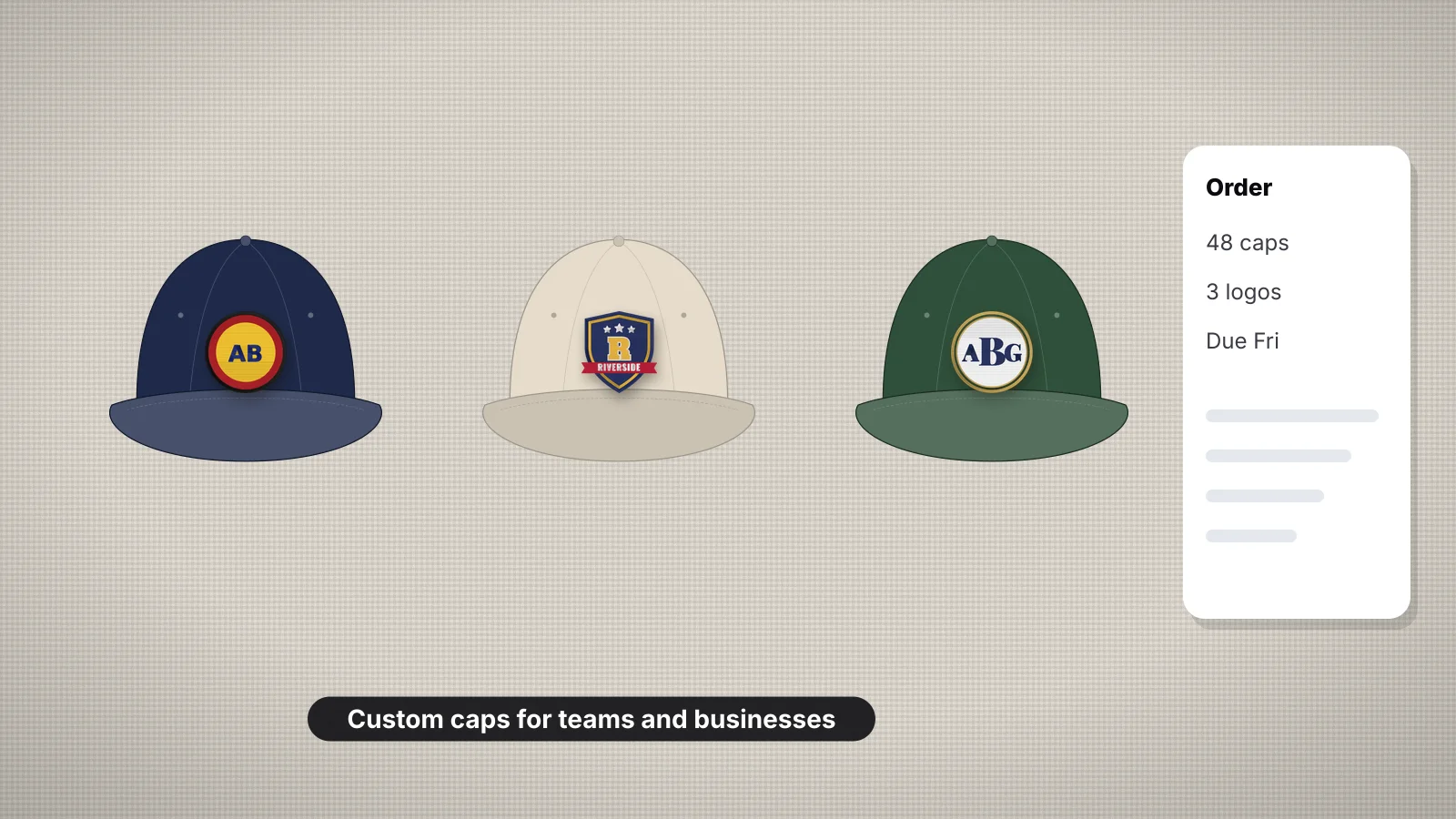
| Trades and local businesses | Crew caps for landscapers, contractors, breweries, coffee shops and real estate offices, often 24–72 with reorders | Bring a mockup of their logo on a cap and a same-day quote |
| Events | Wedding, bachelorette, reunion and golf outing caps, and hat bars with patches | Work back from the event date; a hat bar needs patches made ahead |
| Etsy and online | Names, initials, towns and patch hats | Clear photos, personalization fields and prices that cover fees of roughly 10% |
| Schools and clubs | Spirit caps and fundraisers | Offer a pre-order sheet so you only stitch what's sold |
How to get embroidery customers has message templates and more channels. A cap mockup from the embroidery mockup generator and a printable quote from the quote generator help close local orders. Only stitch a logo for its owner or with permission: team, school and brand logos are usually trademarks.
Practice on a free design
167 ready-to-sew designs in every machine format, free with an account.


Turning customer logos into cap files with Embrizo
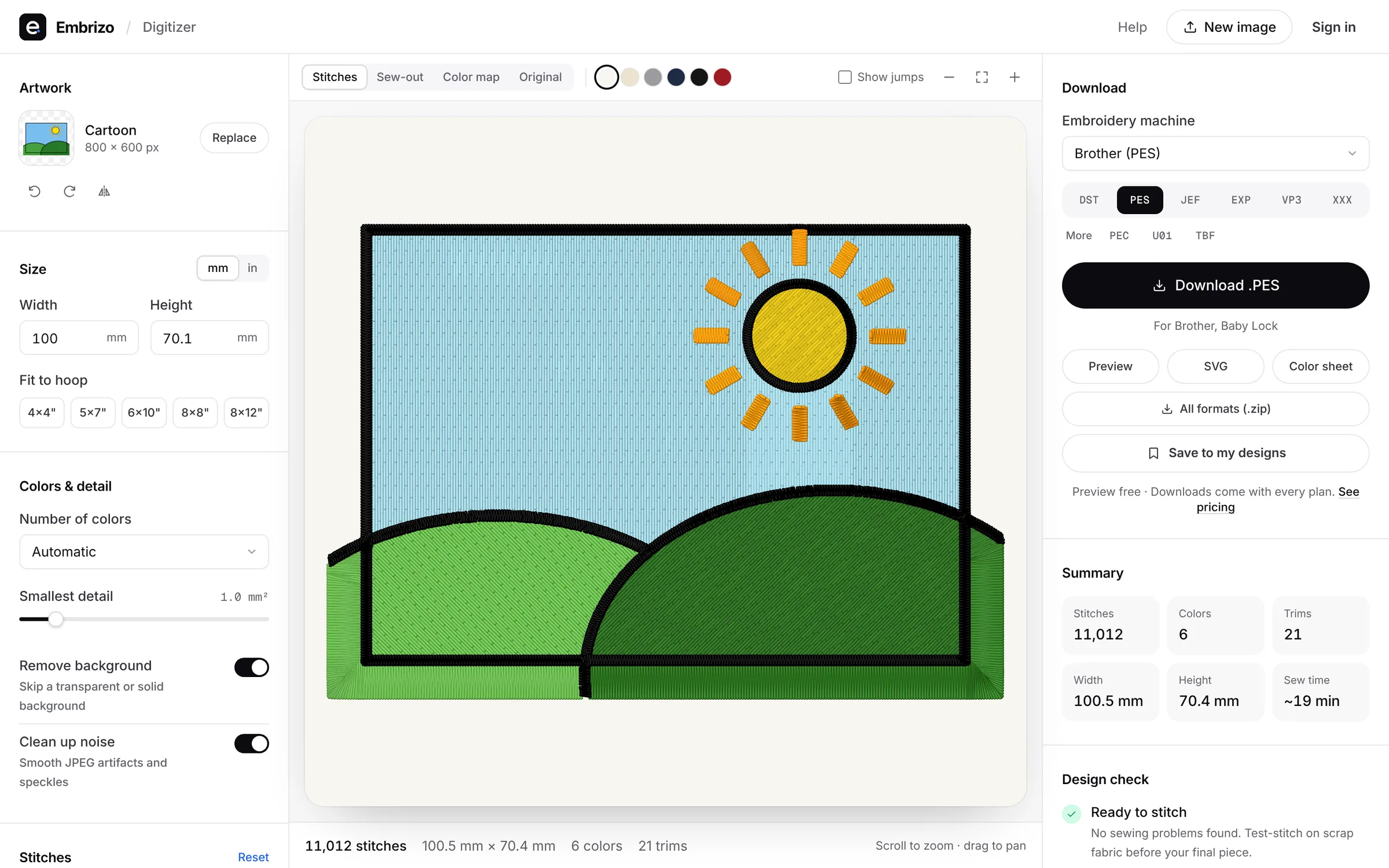
Embrizo's digitizer turns a customer's logo into a cap-sized DST or PES file in minutes, so you can send a stitch preview with the quote instead of waiting days for a digitizer.
- Upload the logo as a PNG, JPG, SVG, PDF or AI file to the digitizer, set the width for the cap, such as 4.25 in (108 mm), and choose the woven fabric preset, which suits most cap twill.
- Read the design check. It flags text and details too fine to sew, many colors and high stitch counts, so you can ask for a simpler logo before the sample.
- Quote from real numbers. The logo stitch estimator digitizes a logo at cap size and shows stitches, colors, run time and a price per piece at your own rate.
- Download your machine's format: DST for Ricoma, Tajima, Happy, Barudan and Melco machines, PES for Brother and Baby Lock, and JEF, EXP, VP3 and others. Designs are saved to your account for reorders.
What it doesn't do: it orders stitches to keep trims and jumps down, not specifically from the center out for caps, and it doesn't make 3D puff files. For bold logos, flat-hooped caps and patch hats that works well; for fine lettering on structured caps, sew a test cap first or have that file sequenced by a hand digitizer. Digitizing and previews are free with an account; downloading files needs a plan.