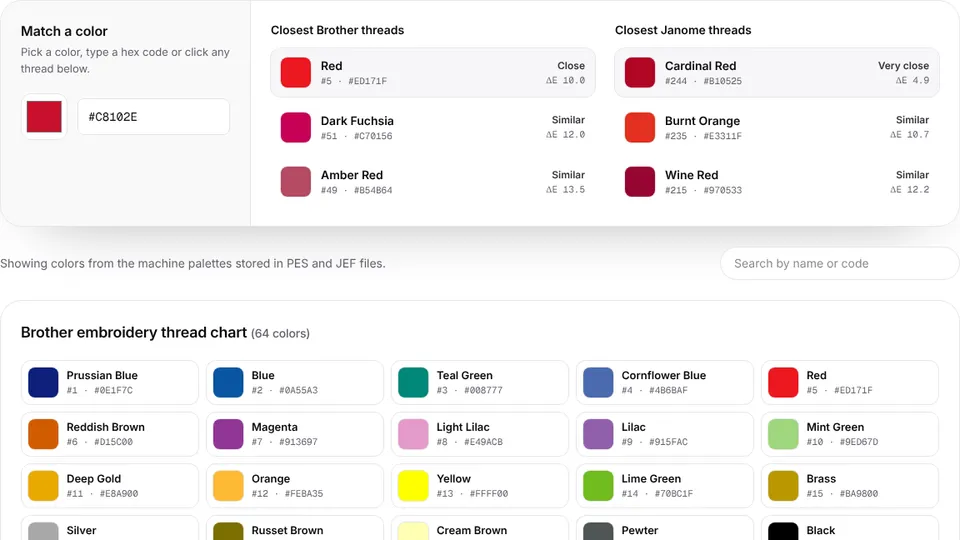
 Free toolThread color chart & matcherBrother and Janome thread charts with codes, plus a color matcher between brands.Open the tool
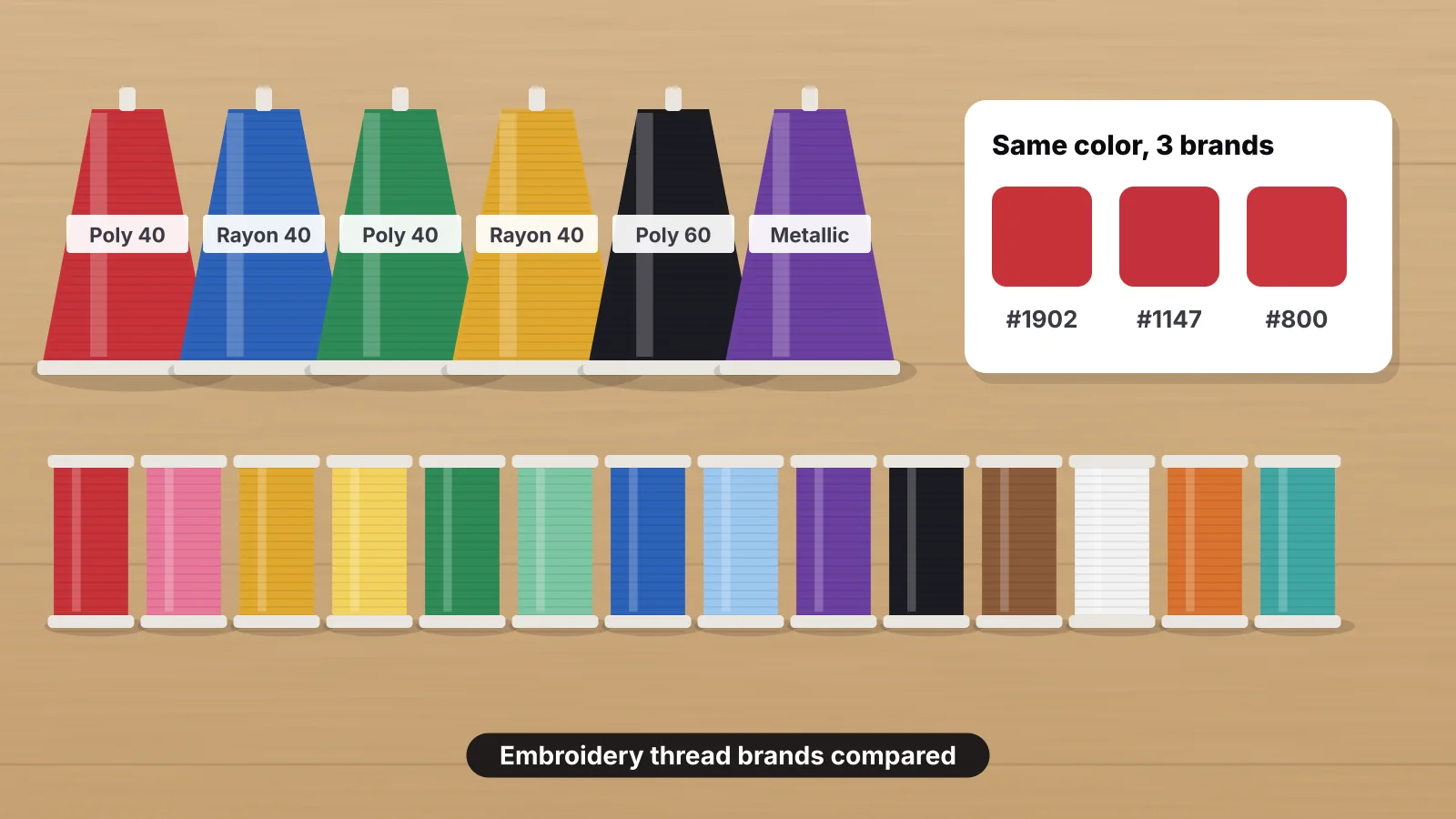
Thread brand debates run long in embroidery groups, but the main brands are more alike than different: each makes 40 wt polyester or rayon that runs well on home and commercial machines. The real differences are fiber, color range, spool size, price and which brand your shop or supplier keeps in stock.
This guide sets out what Madeira, Isacord, Robison-Anton, Sulky, Floriani, Brother and budget kits are known for, with their put-ups and approximate 2026 prices, then covers weights, matching colors between brands and storage. It doesn't rank brands from lab tests; it gives you what you can check yourself. For fibers and how much thread a design uses, start with the embroidery thread guide.
Which embroidery thread brands are most popular?
Most machine embroiderers in the US use one or more of the brands below. Prices are typical US retail listings in late 2026; they vary by shop, color and sale, and kits cost less per spool.
| Brand | Known for | Main lines | Common put-ups | Typical price, about |
|---|---|---|---|---|
| Madeira | A German thread maker dating to 1919, which says it made the first pure viscose (rayon) thread for commercial embroidery | Classic Rayon 40, Polyneon polyester, metallics | 220 yd (200 m) and 1,100 yd (1,000 m) spools; 5,500 yd (5,000 m) cones | 220 yd rayon spool $3.50–$4; Polyneon cone about $10; rayon cone about $13 |
| Isacord | Trilobal polyester from Germany's Amann Group, with a sheen close to rayon | Isacord 40 polyester | 1,000 m (1,094 yd) spools; 5,000 m cones | Spool $6–$8; cone $13–$15 |
| Robison-Anton | A long-standing US brand, owned by American & Efird since 2005 and widely used by commercial shops | Super Brite polyester, rayon | 1,100 yd spools; 5,500 yd cones | 1,100 yd spool $6.50–$7.60 |
| Sulky | Rayon for home embroidery, and a large range of stabilizers | Rayon 40, Poly Deco and PolyLite 60 wt polyester, cotton, metallics | 250 yd and 850 yd spools | 250 yd $4–$7; 850 yd about $8 |
| Floriani | RNK Distributing's brand, also known for stabilizers and embroidery software | Polyester embroidery thread | 1,000 m spools; 5,000 m cones | Spool $5–$7 |
| Brother | Thread sets made for Brother machines | Polyester, such as the 63-spool ETKS63 set | 1,100 yd spools in sets | More per spool than budget kits |
| Budget kits such as Simthread and New brothread | A low price per spool, with spools numbered to match Brother's colors | 40 wt polyester | 500 m (550 yd) spools in 40- and 63-color kits; also 1,000 m spools and cones | 63-spool kits $40–$60, under $1 a spool |
You'll also see Gunold, Coats & Clark and store brands in supply shops. Thread lines, color counts and prices change, so check the maker's current color card before you stock up.
Every brand has good and bad reviews, and many problems blamed on thread come from the needle, the tension or an old spool. Before you switch brands, sew the same test design in both on the same fabric with a new needle.
Madeira vs Isacord: what's the difference?
Both are German brands with ranges of about 400 colors, both sell 40 wt thread on 1,000 m spools and 5,000 m cones, and both appear in almost every conversion chart. The main difference is fiber: Isacord is polyester only, while Madeira sells polyester (Polyneon) as well as the rayon (Classic) it's best known for.
| Isacord 40 | Madeira Polyneon 40 | Madeira Classic Rayon 40 | |
|---|---|---|---|
| Fiber | Trilobal polyester | Polyester | Viscose rayon |
| Look | A high sheen, close to rayon | Bright, with a polyester sheen | Known for its luster |
| Washing | Stands up to hot washes and bleach-based detergents | Stands up to hot washes and bleach-based detergents | Can fade with bleach; best for items washed gently |
| Put-ups | 1,000 m (1,094 yd) spools; 5,000 m cones | 1,100 yd spools; 5,500 yd cones | 220 yd and 1,100 yd spools; 5,500 yd cones |
| Price, about | $6–$8 a spool; $13–$15 a cone | About $10 a cone; 1,100 yd spools often sold in kits | $3.50–$4 for 220 yd; about $13 a cone |
| Colors | About 390 | About 390 solids, plus multicolor and fluorescent shades | About 390 solids, plus ombre and multicolor shades |
For workwear, towels and kids' clothes that are washed often, either polyester suits; pick the one you can buy easily and get its color card. Choose Madeira's rayon for decorative pieces where you want rayon's luster. Many shops keep one polyester brand as their main stock and buy a second brand only for colors the first doesn't have.
Try it with your own design
Sign up free, upload an image and get a stitch preview in under a minute.
Drop your image here
PNG, JPG, SVG, PDF or AI · stays on your device
Not sure what to expect? See real examples or how it works.
Polyester, rayon, cotton or metallic: which brands make what?
Choose the fiber first, then the brand. Polyester is the strongest and most colorfast, rayon has the softest luster, cotton is matte, and metallic adds shine to small areas. The thread guide compares them in detail, and the glossary has entries on polyester and rayon thread.
| Fiber | Best for | Brands and lines |
|---|---|---|
| Polyester, 40 wt | Most jobs, and anything washed often | Isacord 40, Madeira Polyneon, Robison-Anton Super Brite, Floriani, Sulky Poly Deco, Brother and budget kits |
| Rayon, 40 wt | Decorative pieces, gifts and items washed gently | Madeira Classic Rayon, Sulky Rayon 40, Robison-Anton rayon |
| Fine thread, 60 wt | Small lettering and fine detail | Sulky PolyLite 60 wt polyester, Madeira's 60 wt rayon; check each line's colors |
| Cotton | Heirloom, quilting and vintage-style designs | Sulky and other makers; check the weight suits machine embroidery |
| Metallic | Outlines, sparkle and small accents | Madeira, Sulky and others; see metallic thread embroidery |
Commercial shops lean toward polyester because it survives frequent and hot washing, while many home embroiderers still prefer rayon for gifts. Mixing fibers in one design is fine, as long as the weights match and you check the tension after the change.
What does embroidery thread cost per 1,000 m?
Compare thread by price per length, not per spool, because put-ups run from 200 m to 5,000 m. With the typical prices above, the cost per 1,000 m (1,094 yd) works out roughly like this:
| Put-up | Example price | Per 1,000 m, about |
|---|---|---|
| Small rayon spool, 220 yd (200 m) | $3.75 | $19 |
| Rayon spool, 850 yd (777 m) | $8 | $10 |
| Polyester spool, 1,000 m | $7 | $7 |
| Polyester cone, 5,000 m | $13 | $2.60 |
| Budget kit spool, 500 m | $0.75, from a $47 kit of 63 | $1.50 |
Thread is a small share of an item's cost either way. At about 4–6 m of top thread per 1,000 stitches, a 6,000-stitch left chest logo uses roughly 24–36 m: about 17–25¢ from a $7 spool, or 6–9¢ from a cone. Buy cones of the colors you use most and spools of the rest. The thread calculator works out how much of each color an order needs.
Check what your machine holds before you buy cones. Spools up to 1,000 m fit most home machines; 5,000 m cones are made for multi-needle machines and need a cone holder or a thread stand on a home machine.
Do thread weights match across brands?
Mostly, but not exactly. 40 wt is the standard almost every design is digitized for, and every brand above sells it; many 40 wt polyesters are described as 120 denier, 2-ply (120d/2). Brands measure in slightly different ways, so two 40 wt threads can differ a little in thickness and coverage.
- Stay with 40 wt for designs made by others, unless the instructions say otherwise.
- Use 60 wt for small text, such as Sulky PolyLite or a 60 wt rayon, with a 65/9 or 70/10 needle.
- Bobbin thread is separate: finer, usually white or black, and it doesn't need to be the same brand as the top thread.
- Test a new brand on a satin column and a fill before a big job. A slightly thicker thread may need the top tension eased a little.
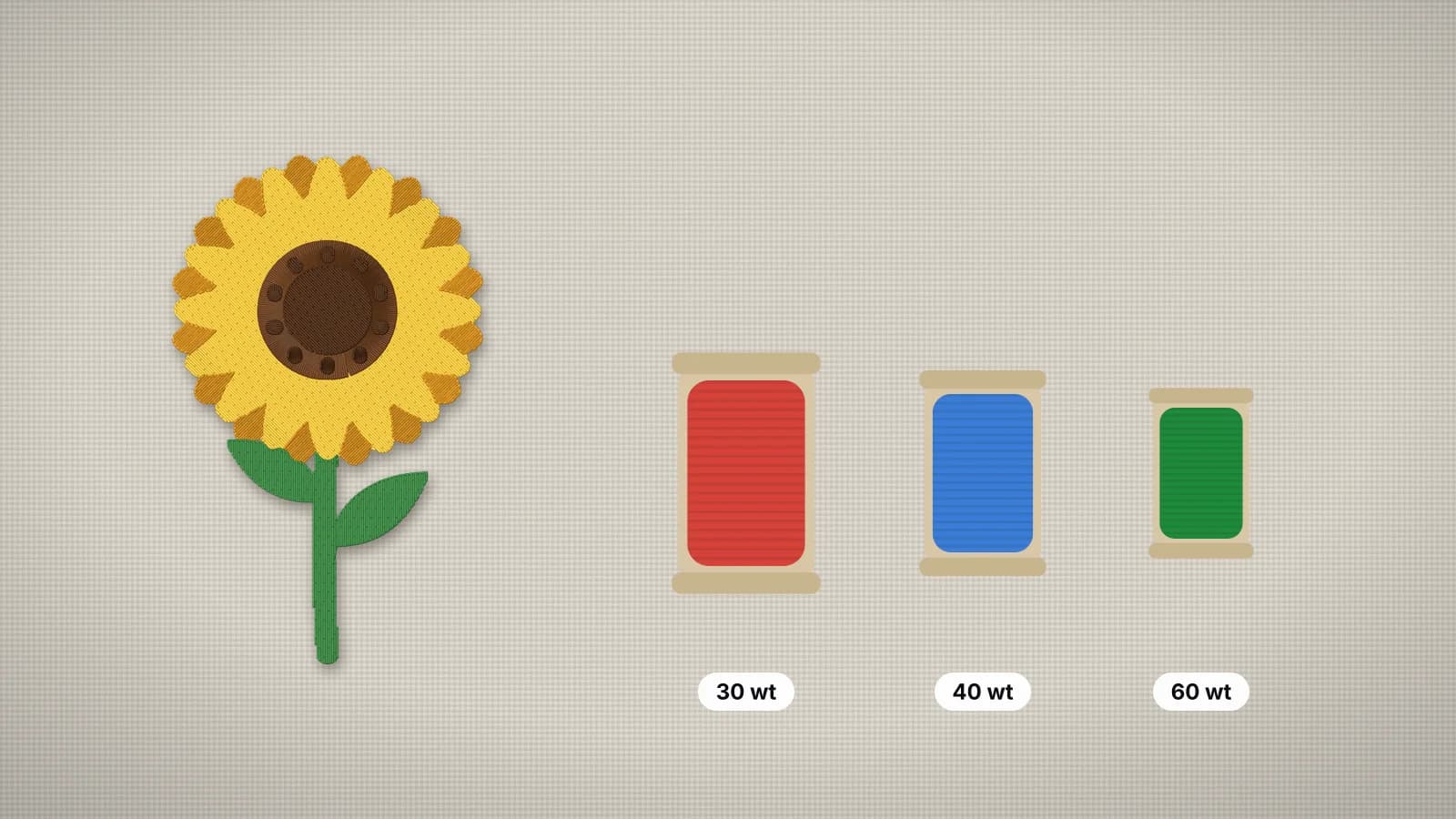
The thread weight guide explains 30, 40 and 60 wt, the needle for each and when a file needs changing for a different weight.
How do you match colors between thread brands?
Convert by color, not by number. Every brand numbers its own colors, so a number in one brand means nothing in another, and a conversion is always the nearest shade rather than the same dye.
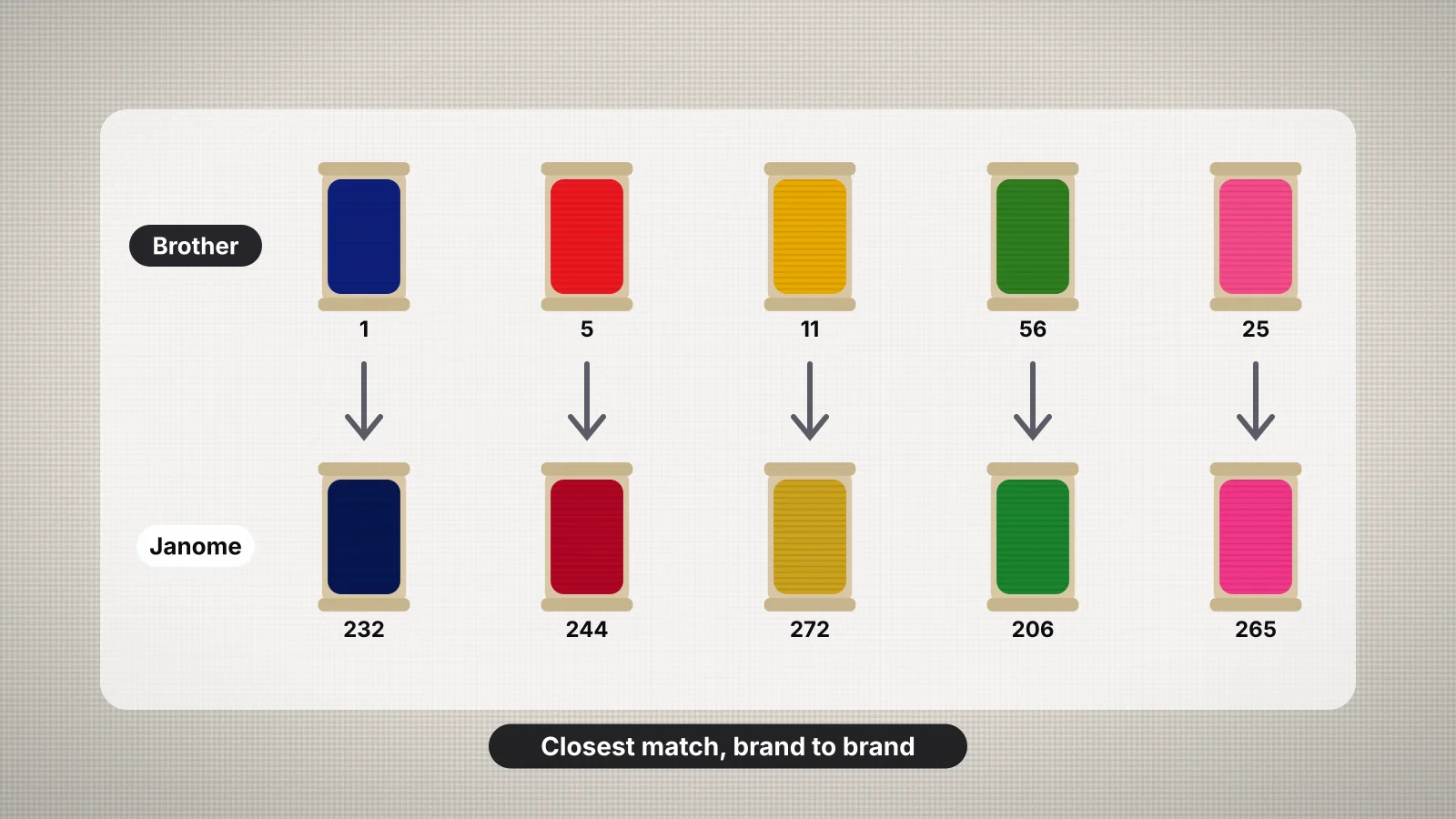
- Use the maker's cross-reference when there is one. Many brands publish charts from other brands to their own numbers, and Brother has charts to Madeira, Sulky and Robison-Anton.
- Some Brother machines can show other brands' numbers on screen, such as Madeira, Sulky and Robison-Anton; look for the thread color setting in your manual.
- Budget kits are numbered to Brother's colors, but they're near matches, not Brother's own thread. Compare the spools when a color matters.
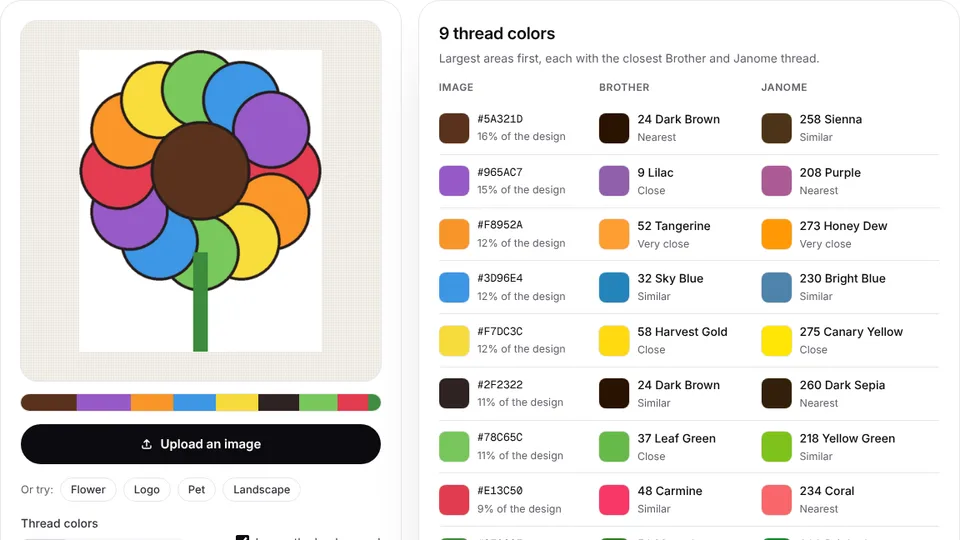
- Look a color up by hex value. The thread color chart lists the colors built into Brother PES and PEC files (61) and Janome JEF files (78), with a matcher that ranks the closest threads in both, and thread colors by name gives the nearest Brother and Janome threads for everyday colors such as navy and red.
- Own a physical color card for the brand you buy most. It's the only reference that shows the real fiber and sheen.
How to convert embroidery thread colors walks through converting a whole design, and thread color matching covers matching a logo's colors and checking them in daylight.
How long does embroidery thread last?
Thread has no expiry date, but light, heat and dry air weaken it over the years. Polyester holds up best; rayon and cotton fade and turn brittle sooner, especially in sunlight.
- Store it closed and dark: boxes, drawers or lidded bins, not an open rack by a window. Cover cones on a thread stand between jobs.
- Keep the ends tidy: tuck tails into the spool's notch or snap-in base, and use a thread net on slippery spools.
- Test old thread before a real job: pull a length between your hands. If it snaps with little effort, or breaks again and again on a test, keep it for practice.
- Buy enough for a job at once, since dye lots can vary slightly from batch to batch.
- Treat secondhand thread as a gamble. Test each spool, and be wary of very old rayon and cotton.
If a thread that used to run well starts breaking, fit a new needle and rethread first, then sew a test with a fresh spool of the same color. If only the old spool breaks, the thread is the problem; why thread keeps breaking covers the other causes.
Practice on a free design
167 ready-to-sew designs in every machine format, free with an account.

Using Embrizo with any thread brand
Embrizo doesn't sell thread, and its built-in charts are Brother and Janome, but the files it makes sew with whatever brand you load:
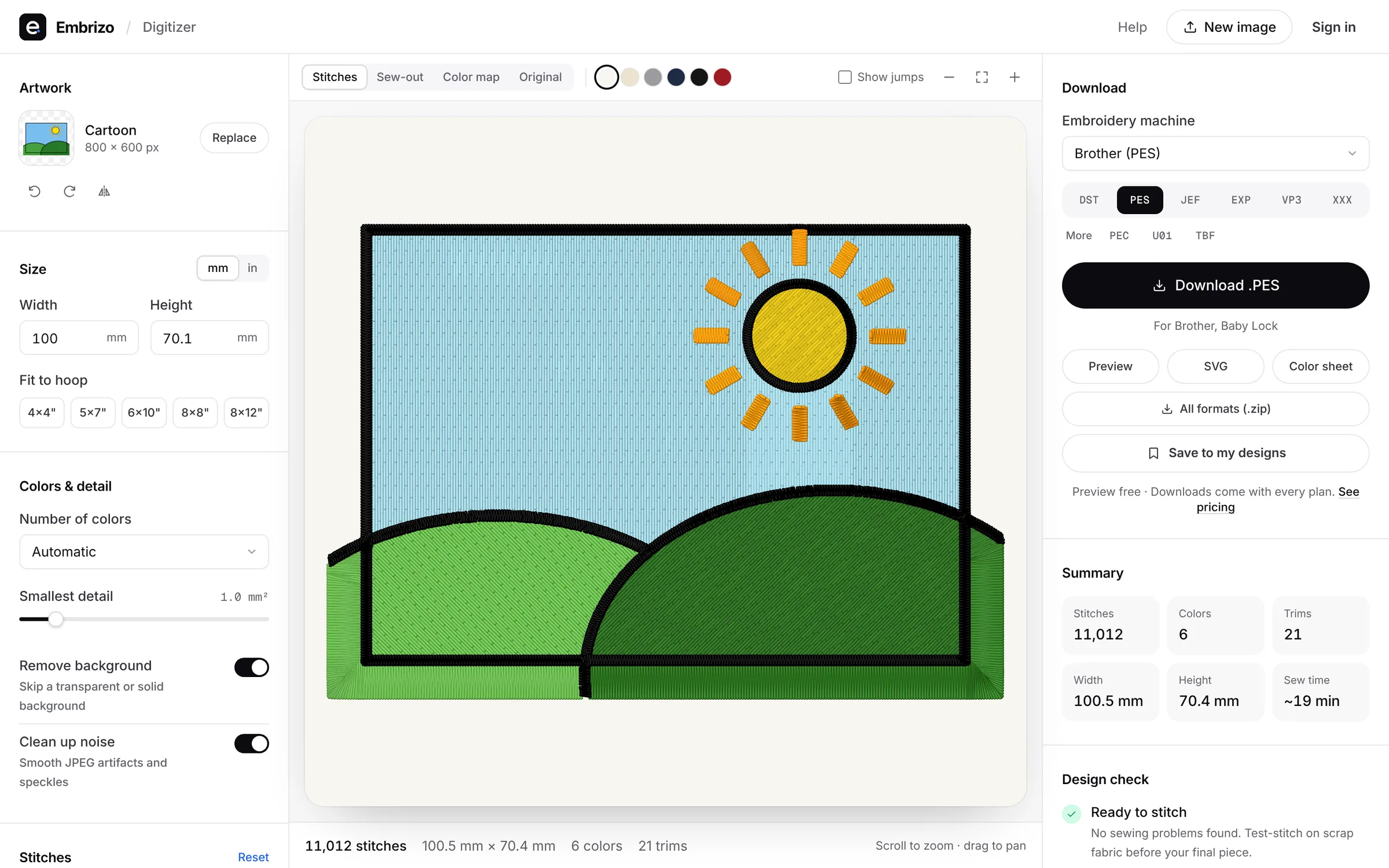
- Choose a chart when you digitize: Brother or Janome threads, or the image's exact colors. In the digitizer you can change any color and merge near-identical shades.
- Every download includes a color sheet listing each color in sewing order with its thread and hex value. Look the hex values up in another maker's chart or color tool to find Madeira, Isacord or Robison-Anton matches.
- See a picture's colors first: image to thread colors shows the thread colors a logo or picture would stitch with, matched to Brother and Janome threads with codes.
- Plan how much to buy with the thread calculator, per color and per order.
A machine sews whatever thread you load at each color stop, so a file made with Brother colors sews just as well in Isacord or Madeira. Digitizing and previews are free with an account; downloading files needs a plan.