 Free toolPlacement templatePrint a design at true size with center cross hairs and measurements to place it on a garment.Open the tool
A birthday shirt with the child's name and age is one of the quickest personalized pieces an embroidery machine makes, and one of the most photographed: worn to the party, in every cake picture and usually kept. Kids' tees are small and stretchy, though, so the design has to be sized for the shirt, the letters kept bold and the knit supported so the design doesn't pucker after the first wash.
This guide covers layouts, sizes for toddler and kids' tees, backing and needle, fonts, appliqué numbers, first-birthday bibs, sibling shirts, a timeline and selling. For the knit basics of every tee, see how to embroider a T-shirt; to lay out a design as you read, open the birthday design maker.
 Free design makerBirthday embroidery design makerType the name, pick lettering and an icon, and see it sized for the item. Then turn it into a file for your machine.Make yours
What goes on an embroidered birthday shirt?
Most birthday shirts combine three things: the name, the age and a motif such as a cake, balloons or the child's favorite animal. The age can be a number, a word or a whole line:
| Layout | Example | Works best for |
|---|---|---|
| Name over a big number | Mia above a large 5 | Ages 2–10, with the number as the focal point |
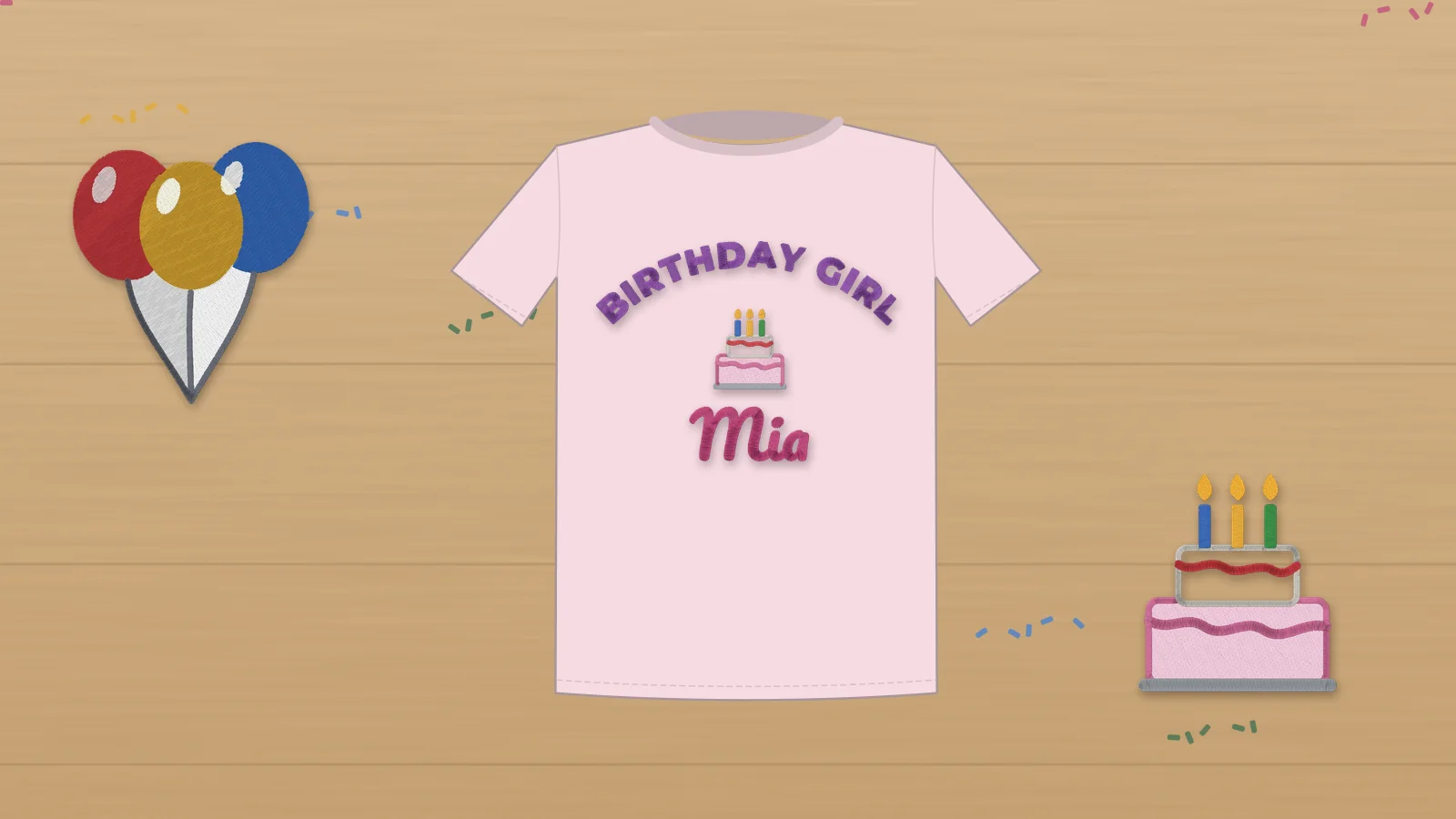
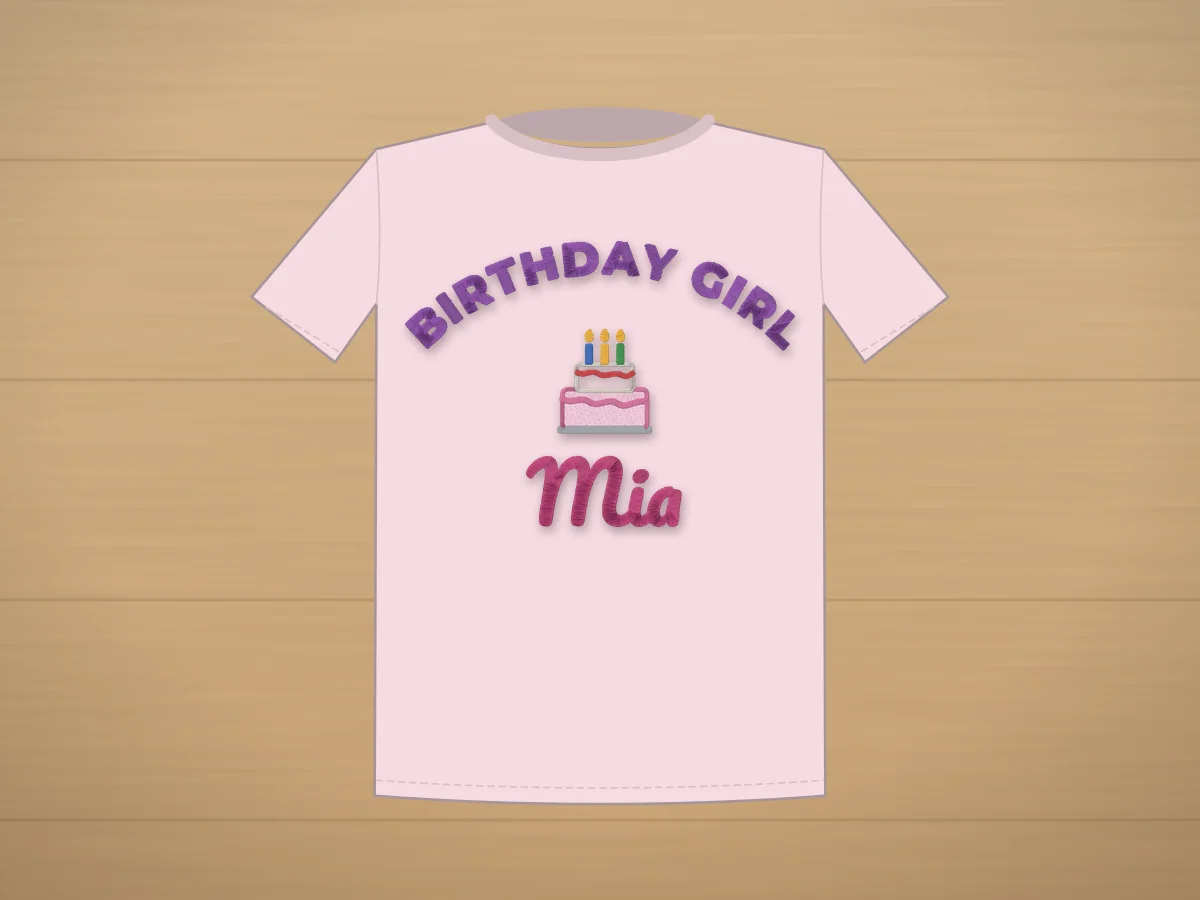
| Birthday girl or Birthday boy arched over a motif | Birthday girl over a cake, the name below | Toddlers and young kids; the line reads from across the room |
| Name, motif and number | Leo, a cake and a 5 beside it | 5–8 in designs on older kids' shirts |
| A line with the age | Is turning 5, or Five | Shirts too small for a big number |
| A number with balloons or a cake | A 3 with balloons tied to it | A simple design with no name |
| The party theme | A dinosaur, unicorn, rocket or soccer ball with the name | Matching the invitation and the cake |
The birthday design maker lays these out from a name, a birthday line such as Birthday girl or Is turning 5, and an icon from Embrizo's free designs, such as a cake, balloons, a dinosaur or a unicorn, sized for a kids' tee, an adult tee or a bib. For favor bags, crowns and banners, see the birthday embroidery ideas.
The free birthday and celebration designs include a two-tier cake with three candles, about 3.4 × 3.7 in (86 × 95 mm), and balloons at about the same size. The cake has 8 colors as drawn; when you digitize a layout with it, setting max colors to 4 or 5 saves thread changes on a single-needle machine.
Where does the design go on a toddler or kids' tee, and how big?
Center it on the chest with the top about 2–3 in below the neckline, and size it to the shirt rather than to your hoop: a design that's right on a 10-year-old's tee wraps into the armholes of a 2T. As a starting point:
| Shirt size | Design width, about | Top below the neckline, about | Hoop |
|---|---|---|---|
| 12–24 months | 3–4 in (75–100 mm) | 1.5–2 in (40–50 mm) | 4×4 or 5×7 |
| Toddler 2T–5T | 4–6 in (100–150 mm): 4–5 in on 2T–3T, 5–6 in on 4T–5T | 2–2.5 in (50–65 mm) | 5×7 up to 4.9 in, 6×10 up to 6 in |
| Kids 6–8, youth S | 6–7 in (150–180 mm) | 2.5 in (65 mm) | 6×10 up to 6 in, 8×8 up to 7.6 in |
| Older kids 10–14, youth M–XL | 7–8 in (180–200 mm) | 2.5–3 in (65–75 mm) | 8×8 up to 7.6 in, larger for 8 in |
| Adults, for matching sets | 7–9 in (180–230 mm) | 3–4 in (75–100 mm) | 8×8 or larger |
Keep the height no more than the width, so a toddler's design stays on the chest, and measure the shirt laid flat, since kids' sizes vary between brands. In the birthday maker, the kids' tee size is 5 in wide and the T-shirt size 7 in.
A 2T often won't fit around a large hoop, so float it: hoop the backing on its own, slide the hoop inside the shirt from the bottom, smooth the front onto it without stretching and clip the back and sleeves out of the way.
Try it with your own design
Sign up free, upload an image and get a stitch preview in under a minute.
Drop your image here
PNG, JPG, SVG, PDF or AI · stays on your device
Not sure what to expect? See real examples or how it works.
Which stabilizer and needle does a birthday shirt need?
Use a backing that stays in, because the knit stretches every time the child moves and every time it's washed: fusible no-show mesh under most birthday designs, with a 75/11 ballpoint needle, whose rounded tip slides between the knit loops instead of cutting them. Then match the backing to how much stitching the design has:
| Design | Backing | Topping | Needle |
|---|---|---|---|
| A name and a line of text, or outlines | One layer of fusible no-show mesh | None on smooth jersey | 75/11 ballpoint |
| A name with a filled cake or balloons, about 8,000–12,000 stitches | Fusible no-show mesh plus a second layer floated underneath, or a medium cut-away (2.5 oz) | None | 75/11 ballpoint |
| An appliqué number | Fusible no-show mesh; fusible web on the appliqué fabric | None | 75/11 ballpoint |
| A thin or performance tee | Fusible no-show mesh | None | 70/10 ballpoint |
| A sweatshirt for a winter birthday | Medium cut-away | Water-soluble | 75/11 ballpoint |
Prewash cotton shirts before you stitch, so they shrink before the design goes on rather than after. Fuse the mesh to the inside of the front only, a little bigger than the design, and trim it to about ¼ in (6 mm) with rounded corners when you're done. In the digitizer, choose the knit preset, or stretch for thin performance tees, which adds the underlay and pull compensation knit needs.
For toddlers, iron a soft cover-back over the inside of the design so the bobbin thread and the edge of the mesh don't rub. The baby clothes guide covers it along with the other safety points for small children, such as no metallic thread, no loose thread tails and no rhinestones.
Which fonts work for names and numbers on kids' shirts?
Bold, simple letters read best from across a party and stitch cleanly on knit, where thin strokes sink and fine joins break up. Keep script and lowercase letters at least 6–8 mm tall and block capitals at least 5 mm, and give the number a heavy face:
| Line | Style | On a toddler tee, about | On an older kid's tee, about |
|---|---|---|---|
| Name | A thick script such as Script (Pacifico), or a soft sans such as Rounded (Fredoka) | Capitals 25–35 mm (1–1.4 in) | Capitals 30–45 mm (1.2–1.75 in) |
| Birthday girl or Birthday boy | The same script, or block capitals | 4–4.5 in (100–115 mm) wide, lowercase about 8–9 mm | 6 in (150 mm) wide, lowercase about 12 mm |
| The number | A heavy slab such as Varsity (Alfa Slab One), or appliqué | 2.5–3 in (65–75 mm) tall | 3.5–4.5 in (90–115 mm) tall |
| Small extras, such as the date | Block capitals | At least 5 mm | 6–8 mm |
Check long names before you promise a size. In a rounded script such as Script, a nine-letter name like Charlotte runs about 4.8 times its capital height, so with 30 mm capitals it's about 5.7 in wide: fine on a 5T, too wide for a 2T. Drop a long name to a smaller height or its own line, or use the name the child goes by. Embrizo's lettering styles list the smallest capital each sews cleanly: 5 mm for Rounded and Block, 6 mm for Varsity, 10 mm for Script.
Pair one script with one heavy face, not two scripts: the name in script and the number in varsity reads best across a room full of kids.
Should the number be appliqué instead of stitched?
For a big number, often yes. Appliqué lays a piece of fabric in the hoop and stitches it down with a satin border, so the number stays soft, takes far fewer stitches than a solid fill at that size and can match the party theme in a cotton print, felt or glitter vinyl. A filled number 3 in tall is a stiff patch on a toddler's tee; an appliqué one moves with the shirt. Step by step:
- Make the number in the appliqué maker: choose Letters, type the number, pick Varsity, Block or Rounded and set the height, about 2.5–3 in (65–75 mm) for a toddler and 3.5–4.5 in for an older child.
- Back the appliqué fabric with fusible web and cut it from the maker's cutting template; tick Mirror if you trace onto the web's paper backing.
- Hoop the shirt with fusible no-show mesh as usual and sew the first stop, the placement line.
- Lay the fabric over the line and sew the tack-down. If you cut the piece oversized, trim close to the tack-down now.
- Sew the satin border, then the name and any motif.
The maker gives the placement line, tack-down and satin border as three color stops, plus the fabric shape at actual size for scissors, a Cricut or a Silhouette; designing and previewing are free, and saving the file needs a paid plan. Prewash cotton prints, and keep the border at least about 3 mm wide so it covers the raw edge. Sew the name as a second design without unhooping, moved into place on the machine's screen.
How do you embroider a first-birthday bib and smash-cake outfit?
For a first birthday, the bib and the outfit are mostly for photos, so keep them small and soft. A bib takes a design about 2.5–3 in (65–75 mm) wide, centered below the neck opening, such as the name and One, or a 1 with a small cake:
- Cotton bibs: a light tear-away and a 75/11 sharp needle. Float a finished bib on sticky stabilizer rather than clamping its padded layers.
- Terry and minky bibs: a cut-away and a water-soluble topping, so the letters don't sink into the loops or the pile.
- The smash-cake bodysuit: a 12- or 18-month bodysuit with a design about 3 in (75 mm) wide, such as ONE or the name with a small cake, on no-show mesh with a 75/11 ballpoint and a soft cover-back. Float it with the snaps open, so only the front is stitched.
- A high chair banner: felt pennants about 5–6 in (125–150 mm) tall, one letter of ONE or the name on each, about 2.5–3 in tall. Stitch each on a felt sheet in a 4×4 or 5×7 with tear-away, then cut the pennant out around it.
- A crown: a felt crown band with a 1 or ONE about 2–3 in (50–75 mm) tall.
Bright frosting can stain, so put the bib on before the smash and save the bodysuit for the photos either side of it.
How do you make matching sibling and family birthday shirts?
Use one layout, one font and one set of thread colors on every shirt, change the line for each person and size each design to its shirt. Lines that work:
- The birthday child: Birthday girl, Birthday boy, or the name and age.
- Siblings: Big sister, Little brother, or the name with Birthday crew.
- Parents: Mom of the birthday girl, Dad of the birthday boy, or just Mom and Dad in the same script.
- Cousins and friends: a name each with the same motif, which also suits party favor bags.
Match the letter height, not the width. Kids stand side by side in photos, so names with the same capital height look like a set even when the designs are different widths: keep the capitals at about 30 mm on every shirt from a 2T to a youth L, and scale the motif instead. Batch name embroidery makes all the names at one height, font and thread from a list, and flags any name wider than the smallest shirt allows; saving the files needs a paid plan.
Measure each design's position from that shirt's neckline, not the hem, and stitch the set in one session so the colors and tension match.
How far ahead should you make a birthday shirt, and how do you make it last?
Stitch it 3–5 days before the party. That leaves time to prewash and dry the blank, test-sew, remake it if something goes wrong and let any topping rinse out and dry. A plan that works:
| When | What to do |
|---|---|
| 1–2 weeks before | Confirm the spelling and the shirt size, and buy the blank plus a spare; popular kids' sizes and colors sell out |
| About a week before | Prewash and dry the shirt, make the file and test-sew it on the spare or an old tee |
| 3–5 days before | Stitch, trim the jump threads and the mesh, and add the cover-back |
| 1–2 days before | Rinse out any topping, dry, press from the inside and fold |
| Party day | A bib over it for the cake |
In a rush, the day before still works on a smooth tee: skip the topping, which saves the rinsing and drying. To make the shirt last past the party:
- Treat frosting fast: scrape it off, run cold water through the back of the fabric and pretreat before washing. Keep it out of the dryer until the stain is gone, since heat can set food coloring.
- Wash inside out in cool or warm water and skip high dryer heat, which also protects the cover-back.
- Leave the backing in. The mesh is what keeps the letters straight after a few washes.
- Press from the back on a towel, never directly on the stitches.
Practice on a free design
167 ready-to-sew designs in every machine format, free with an account.

Can you sell embroidered birthday shirts?
Yes, and they suit a small shop: every child has a birthday every year, the layout stays fixed and only the name, age and shirt change. Embroidered and appliqué birthday shirts on Etsy commonly list at about $25–$40, above most printed ones. A listing needs:
- Drop-downs for shirt size, shirt color, thread color and motif, and a personalization box for the name and age.
- The party date, so you can say whether the order arrives in time, with your processing time on the listing.
- A size chart with each shirt's chest width and the design width you use on it.
- Sibling sets, priced per shirt with a small discount for two or more.
- A rush option for parties inside your processing time, priced for the jump in the queue.
A worked example for a toddler tee with a name, cake and age, with numbers to swap for your own: a $5 blank, $1 of thread, mesh and cover-back, 30 minutes at $25 an hour ($12.50) and $1.50 of packaging come to $20.00. Divided by (1 − 15% fee allowance − 20% profit), that's about $31. Charge a few dollars more for an appliqué number, and send a proof for anything beyond a name and age; the layout in the birthday maker makes a quick one.
In the US, children's clothing you sell falls under the Consumer Product Safety Improvement Act (CPSIA), which covers things such as tracking labels and a Children's Product Certificate; check the CPSC's guidance for small makers before you list. How to sell personalized embroidery covers listings, proofs and returns.