 Free toolEmbroidery machine finderThree questions about what you'll embroider, and the machine models that fit, from their specs.Open the tool
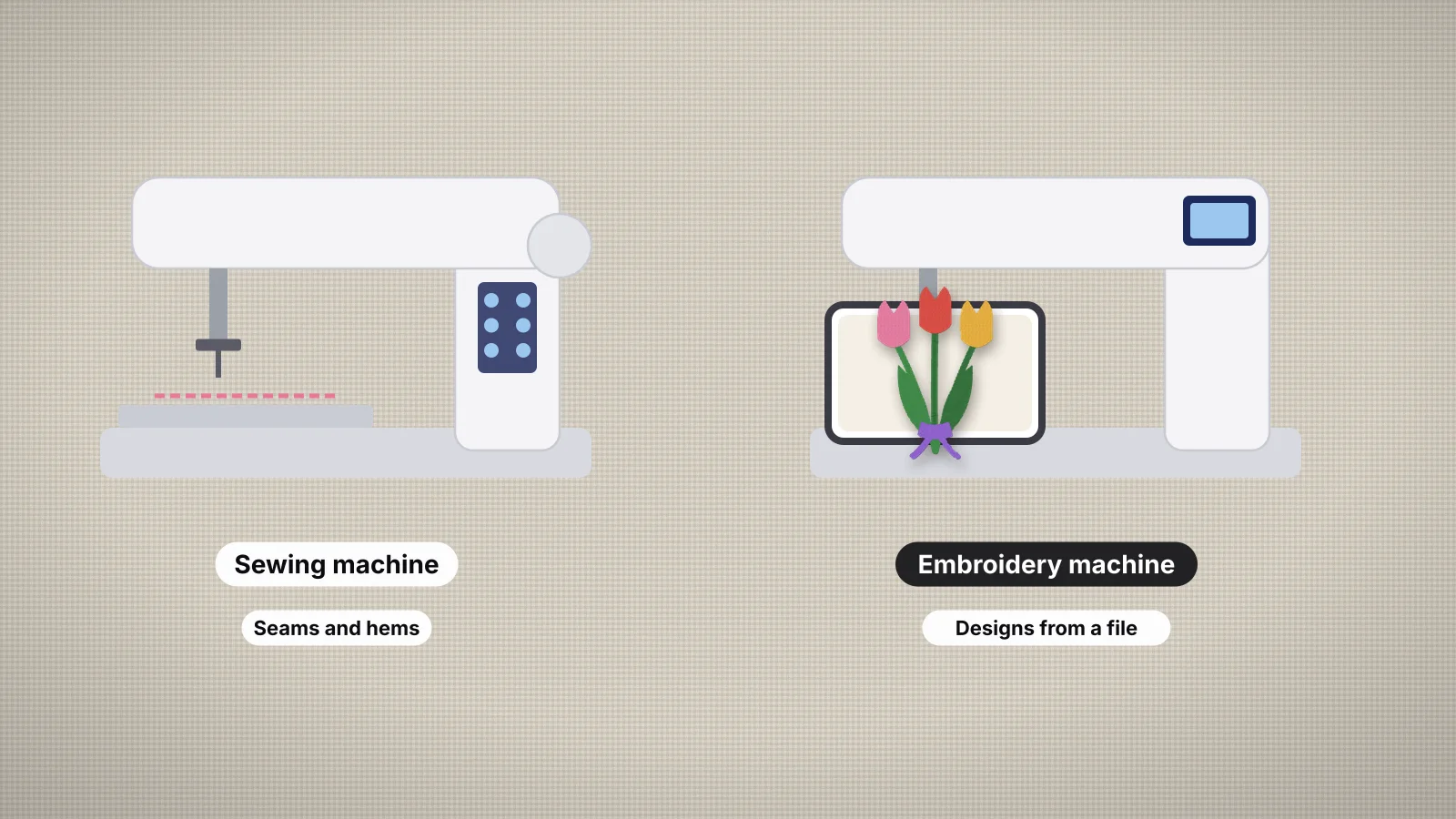
The two machines look alike, and many models do both jobs, so it's easy to buy the wrong one. The difference is who moves the fabric: you, on a sewing machine, or a motorized embroidery arm following a design file, on an embroidery machine.
This guide explains what each machine does, what a sewing machine can and can't embroider, how combo machines work, what each kind costs in 2026, and which to buy for what you want to make.
What is the difference between an embroidery machine and a sewing machine?
A sewing machine joins fabric: its feed dogs pull the fabric forward while you steer, and it sews straight, zigzag and decorative stitches in a line. An embroidery machine decorates fabric: the fabric is clamped in a hoop on a motorized embroidery unit, which moves it in every direction under the needle while the machine follows a stitch file.
| Sewing machine | Embroidery machine | |
|---|---|---|
| What it does | Seams, hems, zippers, buttonholes, quilting and lines of decorative stitches | Logos, names, monograms, pictures and patches from a design |
| Who moves the fabric | You, with the feed dogs pulling it forward | The embroidery unit, moving the hoop front to back and side to side |
| What it follows | Stitches built into the machine | Stitch files such as PES, JEF, DST, EXP or VP3, plus built-in designs and fonts |
| Size limit | Any length of fabric | The embroidery field, from 4 × 4 in (100 × 100 mm) on entry machines |
| Thread | Sewing thread on top and in the bobbin | 40-weight embroidery thread on top, finer bobbin thread underneath |
| Typical new price | About $100–$300 for a basic machine | About $400–$650 for a 4 × 4 in model, $800–$1,500 for 5 × 7 in |
Both form the same lockstitch with a needle and a bobbin, which is why one machine can do both jobs. The embroidery unit, and the design file it follows, are what make the difference.
Can a sewing machine embroider?
A regular sewing machine can't stitch an embroidery design from a file, because it has no way to move the fabric on its own. It can do three kinds of decorative stitching, though:
- Free-motion embroidery. Drop or cover the feed dogs, fit a darning or free-motion foot, stretch the fabric in a hand embroidery hoop so it lies flat against the machine bed, and move the hoop by hand while you sew. You draw with the needle, which is how thread sketching and thread painting are done. It's an art form of its own, but slow, and no two pieces match.
- Built-in decorative stitches and alphabets. Many computerized sewing machines have satin-stitch motifs and a small alphabet for labels and short words; the Brother XR9550, for example, lists 55 alphanumeric stitches. The letters can be no taller than the machine's stitch width, 7 mm on many models, and they're sewn in a line as the fabric feeds through.
- Hand-guided appliqué and couching. You can sew fabric shapes down with a close zigzag by steering round the edge, or couch yarn and cord onto fabric.
What it can't do is sew a logo, a monogram or a multi-color picture from a PES or DST file. For that you need an embroidery unit and a file digitized for it; machine embroidery for beginners covers what else you need.
Some sewing machines can take an embroidery unit later, but only models built for one. Bernina's B 535 and B 570 QE, for example, accept the optional embroidery module M, which dealers list at roughly $1,600–$2,000. A sewing machine without an embroidery connection can't be converted.
Try it with your own design
Sign up free, upload an image and get a stitch preview in under a minute.
Drop your image here
PNG, JPG, SVG, PDF or AI · stays on your device
Not sure what to expect? See real examples or how it works.
Why embroidery needs an embroidery unit and a design file
Machine embroidery works like a printer for thread. A design file lists every stitch as a position, plus jumps, trims and color changes, and the embroidery unit moves the hoop to each position while the needle goes up and down, at about 400–1,050 stitches a minute on home machines. A small logo is often 5,000–10,000 stitches, which is why it can't be done by steering fabric by hand.
- The embroidery unit holds the hoop and moves it. On a combo it attaches to the machine and comes off again for sewing; on embroidery-only and multi-needle machines it's built in. Its travel sets the embroidery field, the largest design one hooping can sew.
- The hoop clamps fabric and stabilizer tight, so nothing shifts while thousands of stitches pull on it.
- The design file has to be in the machine's format: PES for Brother and Baby Lock, JEF for Janome, EXP for most current Berninas, VP3 for Husqvarna Viking and Pfaff, DST for most commercial machines. A JPG or PNG isn't a design file; it has to be digitized into stitches first.
Embroidery file formats explains each format, and the machine compatibility checker tells you whether a file suits a given model and fits its hoop.
What is a sewing and embroidery combo machine?
A combo machine is a computerized sewing machine with a detachable embroidery unit. Take the unit off and it sews like any sewing machine; attach it and it embroiders built-in designs or files from a USB stick or Wi-Fi. Embroidery-only machines have the unit built in and can't sew seams.
| Machine | Sews seams? | Embroidery field | Typical price, about |
|---|---|---|---|
| Brother SE630 | Yes, combo with 103 sewing stitches | 4 × 4 in (100 × 100 mm) | $430–$550 |
| Brother SE700 | Yes, combo with 103 sewing stitches and wireless LAN | 4 × 4 in (100 × 100 mm) | $540–$620 |
| Brother SE2000 | Yes, combo with 241 sewing stitches and wireless LAN | 5 × 7 in (130 × 180 mm) | $1,500 |
| Singer Legacy SE300 | Yes, combo | 10.25 × 6 in (260 × 150 mm) | $700–$1,100 |
| Brother PE900 | No, embroidery-only, with wireless LAN | 5 × 7 in (130 × 180 mm) | $1,000–$1,200 |
| Brother NQ1700E | No, embroidery-only | 6 × 10 in (160 × 260 mm) | $2,000–$2,300 |
The trade-off is time. On a combo you can't sew while it embroiders, and you move the unit on and off between jobs. If you'll do both often, a basic sewing machine plus an embroidery-only machine such as the PE900 costs about the same as one SE2000, or less, and both can run at once. Brother PE900 vs SE2000 compares the two kinds at the same field size, and the combo machine and embroidery-only machine lists cover every model on the site.
How much do sewing and embroidery machines cost?
An embroidery machine costs more than a sewing machine of similar quality, because the embroidery unit, the screen and the design memory add a lot. Typical new US prices in November 2026:
| Machine | Typical price, about |
|---|---|
| Basic sewing machine for beginners | $100–$300 |
| Computerized sewing and quilting machine | From about $300 to several thousand dollars |
| 4 × 4 in combo or embroidery-only machine | $400–$650 |
| 5 × 7 in single-needle machine | $800–$1,500 |
| Large-hoop single-needle and combo machines, about 6 × 10 to 8 × 12 in | $700–$3,500 |
| High-end sewing, quilting and embroidery combos | $7,500–$25,000 |
| Home and prosumer multi-needle machines | $5,500–$13,000 |
Embroidery also has running costs a sewing machine doesn't: stabilizer, embroidery thread in many colors and designs for your own artwork. How much does an embroidery machine cost? breaks each tier down with models, along with the running costs.
Which should you buy: a sewing machine, an embroidery machine or a combo?
Buy for what you'll make most. If you mostly sew and want the occasional monogram, a combo is the value pick; if you mostly embroider, buy an embroidery-only machine with the biggest field you can afford.
| Your goal | Buy | Why |
|---|---|---|
| Clothes, alterations, curtains and quilts | A sewing machine | No embroidery unit to pay for; put the money into a better sewing machine |
| Thread sketches and free-motion art | A sewing machine that drops its feed dogs, plus a free-motion foot | Free-motion work needs no design files |
| Some sewing, plus names and small designs | A 4 × 4 in combo such as the Brother SE630 or SE700 | One machine and one budget, about $430–$620 |
| Sewing, plus towels, totes and chest designs | A 5 × 7 in combo such as the Brother SE2000 | Room for most home embroidery projects |
| Mostly embroidery, and you already sew | An embroidery-only machine such as the Brother PE900 (5 × 7 in) or NQ1700E (6 × 10 in) | Always set up to embroider, and both machines can run at once |
| Selling hats, team gear and repeat orders | A multi-needle machine | Automatic color changes and cap frames; see single vs multi-needle machines |
The embroidery machine finder asks what you'll embroider and suggests models from their specs. How to choose an embroidery machine and the best embroidery machine for beginners go through field size, formats and transfer in detail, and the machine pages list the field, formats and transfer method of each model.
Practice on a free design
167 ready-to-sew designs in every machine format, free with an account.

Getting designs for an embroidery machine
Whichever embroidery machine you buy, it needs designs. Built-in designs and fonts get you started, and the free designs come in every main format. For your own logo, a name layout or a drawing, the Embrizo digitizer turns a PNG, JPG, SVG or PDF into a stitch file: it separates the colors, picks satin, fill or running stitch for each shape and adds underlay, then saves PES, JEF, DST, EXP, VP3, XXX and more.
- Free with an account: digitizing, the stitch preview and sew-out animation, the design check and the free designs.
- Needs a plan: downloading the machine files you digitize; see pricing.
- What it doesn't do: it doesn't control a sewing machine or help with free-motion work, and it doesn't send files to the machine; you copy them to a USB stick or use your machine's own app.
It runs in the browser on Windows, Mac, Chromebook, iPad and Linux, so it works with whichever machine you choose.