 Free toolLettering size calculatorSee how tall your letters will be at a given width, per font, and whether they'll sew cleanly.Open the tool
A birth announcement embroidery, often called a birth stats design, puts a new baby's name, birth date, time, weight and length into one keepsake: hoop art for the nursery, the corner of a baby blanket, a pillow or a quilt. It's a favorite personalized gift and a steady custom order on Etsy, and easy to get wrong: a misspelled middle name, a layout that doesn't fit the hoop, or stats so small they fill in.
This guide covers the details and their order, layouts, fonts, sizes, fabric and hooping, finishing, safety and pricing. To lay one out now, the birth announcement maker arranges the name, date and stats with a motif and checks that the small lines are big enough to stitch.
What details go on a birth announcement embroidery, and in what order?
Put the details in the order people read them: the name first and largest, then the date, then the smaller stats. Top to bottom:
| Order | Detail | Example | Size |
|---|---|---|---|
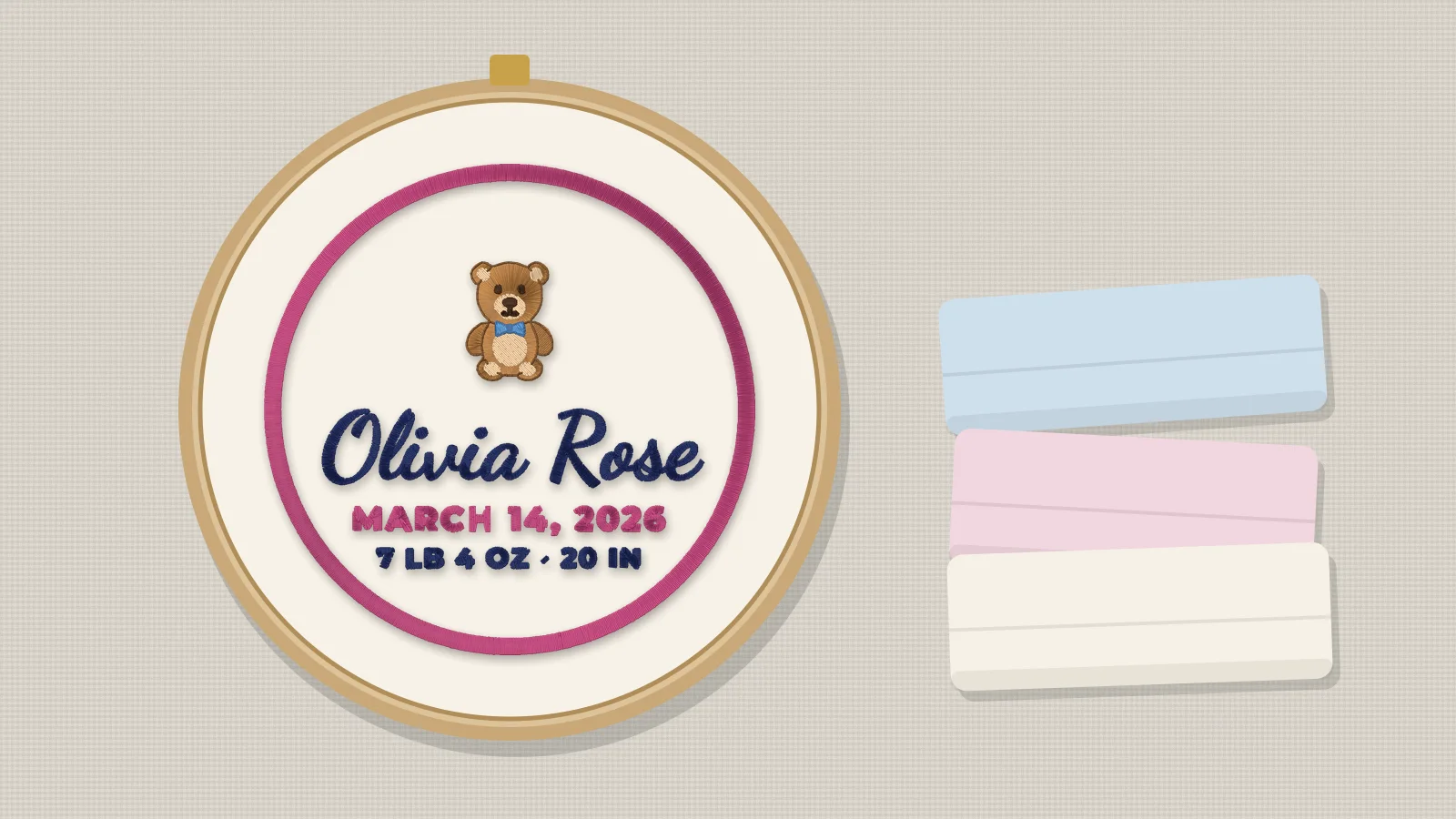
| 1 | Motif (optional) | A sleepy moon, a teddy bear or a flower | About 1–1.5 in (25–40 mm) tall |
| 2 | First name, or first and middle | Olivia Rose | The largest line: capitals 15–30 mm |
| 3 | Last name (optional) | Bennett | About half the first name's height |
| 4 | Date of birth | March 14, 2026 | Capitals 6–8 mm |
| 5 | Time | 4:32 AM | Same as the stats; it can share the date's line |
| 6 | Weight and length | 7 lb 4 oz · 20 in | Capitals 5–8 mm, usually one line |
| 7 | Place (optional) | Born in Portland, Oregon | The smallest line, at least 5 mm |
Five lines plus a motif is about the most a 4–5 in (100–125 mm) design holds with the small lines still at 6 mm, so combine lines if the parents want more: the date and time on one, the weight and length on another. In a 4×4 hoop, keep it to the name and the date, or the stats come out under 5 mm and fill in.
- Units. In the US, pounds and ounces (7 lb 4 oz) and inches (20 in); in most other countries kilograms and centimeters, such as 3.4 kg and 52 cm. Use what the parents used on their own announcement.
- Halves. Write 20.5 in rather than a small ½ character, whose tiny numbers fill in.
- Punctuation. A colon or decimal point is a dot about 1 mm across at 6 mm capitals, which still stitches; at 4 mm it closes up.
Which layout works best for birth stats?
Pick the layout for the item: hoop art wants a roughly round shape, a blanket corner a compact block and a pillow a wider rectangle.
| Layout | How it looks | Best for |
|---|---|---|
| Stacked and centered | The motif on top, the name, then the date and stats on short centered lines | Hoop art, pillows and quilt blocks; the easiest to read |
| Round frame | A circle or wreath around the name, with the stats inside or just below | Display hoops, because the shape matches |
| Icon beside | The motif on the left, the name and stats in a block on the right | Wide spaces, such as a pillow front |
| Arched name | The name curved over a motif, the stats straight below | Hoop art and pillows; short names arch best |
Shape matters most in a display hoop. A block of text fits a circle by its diagonal, so a layout 4.5 in wide and 3.5 in tall is about 5.7 in corner to corner and won't fit the roughly 5 in (125 mm) a 6 in display hoop leaves for the design. Keep the widest line, usually the name, across the middle and the lines above and below it shorter.
The birth announcement maker does the layout for you:
- Type the details: the name, the date and the weight and length, with the time on the last line if wanted.
- Pick a layout and a motif, such as the round frame for hoop art, with a teddy bear, a sleepy moon, an elephant or any free design.
- Choose the size: a 5×7 or 4×4 hoop, a blanket corner or a pillow front. The maker warns you if the small lines come out under 5 mm.
- Turn it into a file. The digitizer stitches the name in satin, shows every stitch and saves PES, DST, JEF and other formats. Digitizing and previews are free with an account; downloading the file needs a paid plan.
For a matching bib or onesie, the baby name maker sets the name in the same lettering and motif, sized for the smaller item.
Try it with your own design
Sign up free, upload an image and get a stitch preview in under a minute.
Drop your image here
PNG, JPG, SVG, PDF or AI · stays on your device
Not sure what to expect? See real examples or how it works.
Which fonts stitch well for a baby's name and small stats?
Use two styles: a script or a serif for the name, and a bold, simple sans in capitals for the stats. Thin strokes and tight loops fill in first, so the smaller the line, the plainer the font.
| Line | Lettering that works | Smallest | Comfortable |
|---|---|---|---|
| Name in script | A rounded script, a flowing script or a bold brush script | Lowercase 6–8 mm tall, about 10–12 mm at the capitals | Capitals 15–30 mm |
| Name in serif | A classic or slab serif | Capitals about 7–8 mm | Capitals 12–20 mm |
| Date and stats | Block, rounded or sport capitals | 5 mm | 6–8 mm |
| A long stats line | Condensed capitals, such as a tall sans | 6 mm | 7–8 mm |
| Place or a short phrase | Block or rounded capitals | 5 mm | 6 mm |
- Add 1–2 mm on minky, fleece and terry. Pile hides detail even with a topping, so stats that are fine at 6 mm on linen want 7–8 mm on minky.
- Set the stats in capitals. Small lowercase letters are only about two-thirds of the capital height, so they fill in first.
- Use one script per design. A script name over block-capital stats is the classic look.
- Under 5 mm, switch to 60 wt thread with a 65/9 or 70/10 needle and test first.
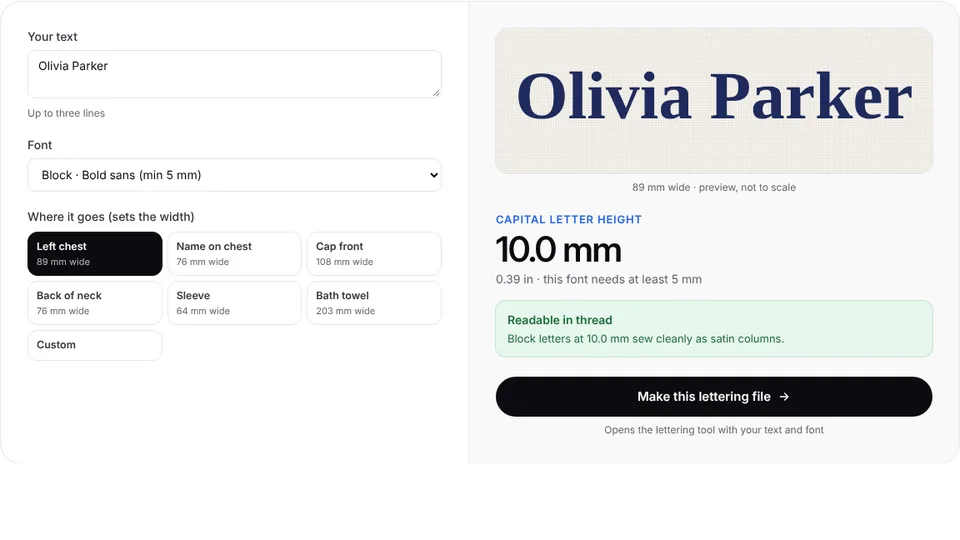
The embroidery fonts previewer stitches a name in 12 lettering styles with the smallest size each can be sewn. Long names come out shorter at the same width, so check before you promise a size: the lettering size calculator shows how tall a name will be at your width, and Maximilian at 4.5 in wide is far shorter than Mia.
What size should a birth announcement be for hoop art, a blanket, a pillow or a quilt?
Size it for the item first, then check your machine hoop can stitch it. A 5×7 hoop sews up to about 4.9 × 6.9 in (124 × 174 mm), which covers hoop art, blanket corners and quilt labels; most pillows want a 6×10 or 8×8.
| Item | Design size, about | Name capitals | Stats | Machine hoop |
|---|---|---|---|---|
| Hoop art, 6 in display hoop | 4–4.9 in (100–124 mm) wide, inside a 5 in (125 mm) circle | 15–25 mm | 6–7 mm | 5×7 |
| Hoop art, 7–8 in display hoop | 5.5–7 in (140–175 mm) across | 20–30 mm | 7–8 mm | 6×10 or 8×8 |
| 5×7 in picture frame | 3.5 × 5.5 in (90 × 140 mm), portrait | 15–25 mm | 6–7 mm | 5×7 |
| Baby blanket corner | 4–5 in (100–125 mm) wide | 20–30 mm | 7–9 mm on minky or fleece | 5×7 |
| Nursery pillow, 12–18 in | 6–7 in (150–180 mm) wide | 25–35 mm | 8–10 mm | 6×10 or 8×8; a 5×7 stops at about 4.9 in |
| Quilt label or block | About 4 in (100 mm) on a label; 6–7.5 in (150–190 mm) on a center block | 12–35 mm | 5–9 mm | 5×7 for a label; 8×8 for a block |
| Newborn bodysuit | 2.5–3 in (65–75 mm) wide; the name and date, or a name from the baby name maker | 12–15 mm | 5–6 mm | 4×4 |
On a blanket, fold it the way it will be given and put the design on the diagonal of the corner that shows, its center about 4–5 in (100–125 mm) in from both edges so it clears the binding. A five-line design with a small motif is usually about 6,000–10,000 stitches: 10–20 minutes of sewing at 600–800 stitches a minute, plus color changes.
Which fabric and stabilizer should you use for birth stats?
Match the backing to the fabric, and add a water-soluble topping to anything with pile. Minky and fleece both stretch and their pile swallows small letters, so they always need a cut-away underneath and a topping on top.
| Fabric | Used for | Backing | Topping | Needle |
|---|---|---|---|---|
| Linen or quilting cotton | Hoop art, quilt labels and blocks | Medium tear-away, or white no-show mesh under dense designs | Not needed | 75/11 sharp |
| Minky | Blankets and pillows | Medium cut-away, bonded with temporary spray adhesive | Water-soluble, always | 75/11 ballpoint |
| Polar fleece | Blankets | Medium cut-away, or no-show mesh for light designs | Water-soluble, always | 75/11 or 80/12 ballpoint |
| Cotton muslin or double gauze | Swaddles and light blankets | Fusible no-show mesh | Helps on crinkled gauze | 75/11 sharp |
| Cotton canvas or linen-look cushion fabric | Pillow covers | Medium cut-away, fusible on loose weaves | Not needed | 75/11 or 80/12 sharp |
| Cotton knit | Bodysuits | Fusible no-show mesh, plus a soft cover-back | Not needed | 75/11 ballpoint |
- Prewash cotton, muslin and quilt fabric so it shrinks before the design goes on. Minky and fleece are polyester and barely shrink.
- Use polyester thread on blankets and anything washed often; it generally holds its color through frequent washing better than rayon.
- Minky sheds from every cut edge: lint-roll the pieces before they go near the machine.
How to embroider a blanket goes deeper on fleece, minky and knit blankets, including the backing that shows on the reverse.
How do you hoop a blanket, a pillow or hoop art fabric?
Hoop flat fabric drum-tight, float anything thick or plush, and stitch pillow and quilt pieces before they're sewn together:
- Hoop art fabric. Cut it at least 10 in (250 mm) square for a 6 in display hoop, so it clamps in the machine hoop and leaves 1.5–2 in beyond the display hoop. Press it, mark crosshairs in water-soluble pen and hoop it on the straight grain.
- Minky and fleece blankets. Don't force thick pile into a standard hoop. Hoop sticky backing on its own, press the corner onto it with your diagonal line on the hoop's center line, add the topping and sew a basting box round the design. A magnetic hoop clamps plush without crushing it.
- Pillow covers. Embroider the front panel before the cover is sewn, cut at least 2 in (50 mm) larger than the pattern all round, then trim it. On a ready-made cover, unzip it and hoop only the front.
- Quilt blocks. Cut the block 1–2 in (25–50 mm) larger all round than its unfinished size, stitch, then trim it square around the design.
Roll the rest of a blanket on the table so its weight can't drag the hoop, and check underneath that only one layer, the backing and the topping are under the needle. Then trace the design outline to check it clears the hoop.
How do you finish a birth announcement in a display hoop?
Mount it in a wooden display hoop about 1 in (25 mm) larger than the design, so a 4.5–5 in design sits in a 6 in hoop. Then:
- Tear the tear-away gently, or trim cut-away about ¼ in (6 mm) from the stitches with rounded corners. Clip every jump thread and press face down on a towel.
- Center the design with the hoop's screw at the top, in line with the middle of the name, so the piece hangs straight.
- Pull the fabric drum-tight a little at a time all the way round and tighten the screw.
- Trim the fabric to a circle 1–1.5 in (25–40 mm) beyond the hoop, then gather it with a running stitch or glue it to the back of the inner ring.
- Cover the back with a felt circle cut just inside the inner ring. Write the baby's name, the date and your name on it first: parents keep the back too.
Going in a 5×7 in picture frame instead? Stretch the fabric over the frame's backing board, lace or tape it at the back, and use a mat or spacers so the glass doesn't flatten the stitches.
Machine embroidery hoop art covers the three ways to finish the back, hanging and photos.
How do you keep embroidered baby items safe?
The risks come from extras and the finish, not the stitching. On anything a baby touches:
- No hard or small add-ons. Skip buttons, beads, sequins, rhinestones, plastic eyes and charms on blankets, pillows, bibs and bodysuits: they can come loose and are a choking hazard. Stitch details in thread.
- No long ribbons or loops on anything that goes in or near a crib.
- Trim every jump thread and tail close on both sides, so no loops can catch small fingers.
- Keep the back soft. Trim the backing with rounded corners and fuse a soft cover-back over the stitches on clothing; on a blanket you sew yourself, embroider the top layer before it's lined.
- Skip metallic thread on anything held against skin; it's scratchy.
- Hang hoop art away from the crib, not above it.
Blankets, pillows and quilts make lovely keepsakes, but the American Academy of Pediatrics advises keeping pillows, quilts and loose blankets out of a baby's sleep space for the first year. Say so on the care card and in any listing: for awake time, photos and display until then.
If you sell items made for children 12 and under in the US, the Consumer Product Safety Improvement Act (CPSIA) applies, including tracking labels and a Children's Product Certificate; the CPSC has guidance for small batch makers.
Practice on a free design
167 ready-to-sew designs in every machine format, free with an account.
How do you collect the details and price custom birth announcement orders?
Get everything in writing, typed by the customer, and send a proof before you stitch. Ask for:
- The name exactly as it should appear, with capitals, hyphens and accents, such as Zoë or Mary-Kate. Check the lettering has the accented letter before you promise it.
- The date with the month as a word. 03/04/2026 is March 4 in the US and 3 April in the UK.
- The time with AM or PM, and the weight and length in the units they want.
- Optional lines and style: the place of birth, thread and fabric colors from a short menu, the lettering and the motif.
- The deadline, such as a baby shower.
Many birth announcements are ordered before the baby arrives: take the order with the name, colors and a layout from the birth announcement maker, collect the stats after the birth, and count your turnaround from when they arrive. Proof it on a mockup, such as the embroidery hoop mockup, and get a written yes: one wrong digit can't be unpicked cleanly.
Price it above a name alone, since every order needs a new layout and a careful proof. A worked example for a 6 in hoop with a motif:
| Cost | Example | Amount |
|---|---|---|
| Hoop, fabric, stabilizer, felt and thread | A 6 in beech hoop on linen | $5.00 |
| Packaging | A box, tissue and a care card | $2.00 |
| Your time | Layout, proof, stitching, finishing and packing: 60 minutes at $25 an hour | $25.00 |
| Total cost | Before fees and profit | $32.00 |
| Price | Covers about 10% in Etsy fees and leaves about $18 profit | About $55 |
On a blanket or pillow, add the blank and a markup. The pricing calculator works out a per-piece price from the stitches, the blank and your time, and the quote generator turns it into a printable quote. Embrizo's free designs may be stitched on items you sell, but the files themselves can't be shared or resold.