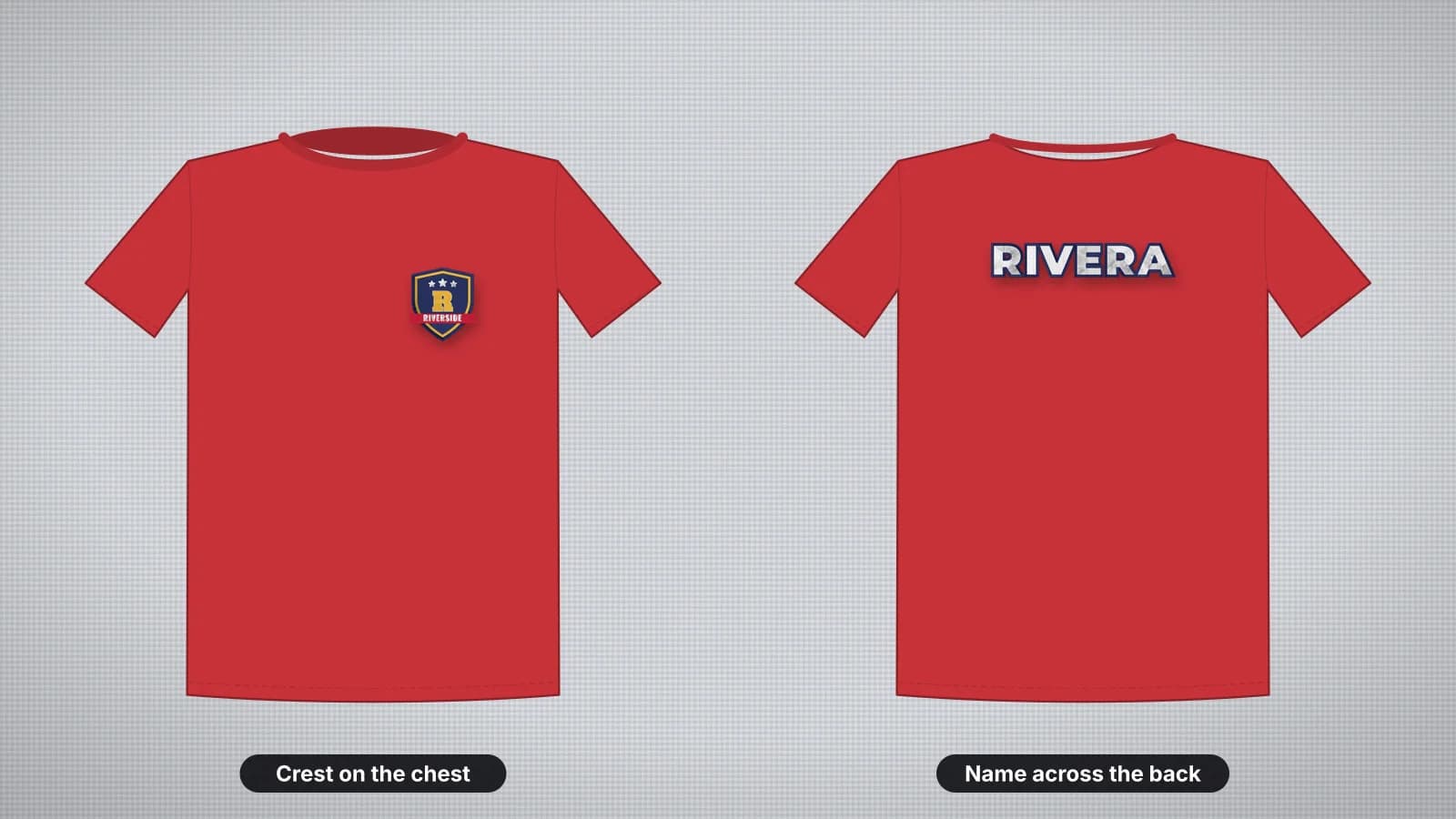
A team order is the same job many times over, with one thing changing: the name. The jerseys need to match each other, read from the stands and survive a season of washing, on fabric that's thin, slippery and stretchy. Get the template right once and the rest of the roster is repetition.
This guide covers where names go and how big, fonts that read from a distance, what big letters do to the stitch count, batching a roster, stabilizer and needles for performance fabric, and an order sheet that prevents reprints. For names in general, start with how to embroider names.
Placement and sizes
| Placement | Where it goes | Typical size |
|---|---|---|
| Back name | Centered across the upper back, a few inches below the collar seam, above the number | Capitals often about 1.5–3 in (38–75 mm) tall; the name up to about 10–11 in (250–280 mm) wide |
| Chest name | Right chest, opposite a crest | 2–3.5 in (50–90 mm) wide, capitals about 8–13 mm |
| Team name on the front | Centered across the chest | 4–8 in (100–200 mm) wide at center chest, 8–12 in for a full front |
| Back of the neck | Just below the back collar seam | One line, 2–4 in (50–100 mm) wide; see back of neck |
| Sleeve | Outside of the upper sleeve | 2.5–3.5 in (65–90 mm) wide; see sleeve |
Measure the back name from the collar seam down and keep that distance the same on every jersey, scaling it a little for youth sizes if the team agrees. Mark each jersey with the placement template printed at true size; the placement guide covers every position.
Check the hoop before you set the size. A 10 in (250 mm) back name needs an 8×12 in hoop turned sideways, or larger; in a 5×7 in hoop the limit is about 6.8 in (174 mm).
Fonts that read from a distance
A jersey name is read from across a field, not at arm's length. Bold, even strokes and simple shapes read best:
| Font | Why it works | Use it for |
|---|---|---|
| Varsity | Heavy slab capitals: the classic team look | Back names, team names and numbers |
| Block | Bold sans with even strokes | Back and chest names |
| Sport | A condensed sans that fits long names | Long surnames, sleeves and chest names |
| Tall | Condensed capitals | Very long names in limited width |
| Scripts such as Brush | Lively, but harder to read at a distance | Large team names on the front only |
- Use capitals for back names. They read better from a distance and keep every name the same height.
- One font for the whole roster. A different font on one jersey looks like a mistake.
- Open up the letter spacing a little. Letters that look fine on screen can merge from the stands.
- Contrast with the jersey: a light thread on a dark jersey, or the reverse. A team color close to the jersey color disappears.
The best fonts guide and the font previewer show each font stitched, with the smallest size it sews cleanly.
Try it with your own design
Sign up free, upload an image and get a stitch preview in under a minute.
Drop your image here
PNG, JPG, WebP or SVG · stays on your device
Big back names: satin, fill or twill
Back-name letters are big, and big letters sew differently from chest names:
- Strokes up to about 6.5 mm wide sew as satin, which is glossy and fairly light. Embrizo uses satin up to 6.5 mm and switches wider strokes to fill.
- Wider strokes sew as fill, which covers well but adds stitches and stiffness, and that shows on a thin jersey.
- Condensed fonts help. A narrower font such as Sport or Tall keeps strokes in satin range at a bigger height.
- Tackle twill is the traditional choice for big names and numbers: fabric letters sewn down with a satin or zigzag edge, which stay lighter and more flexible than large filled letters. It's a form of appliqué and needs files made for it; Embrizo doesn't make appliqué files.
Check the stitch count of one name before you quote a team. The stitch count calculator estimates it, and the production calculator turns it into time for the whole order.
Batching a roster of names
A team order is the same layout with a different name on each jersey. Batching keeps them consistent and saves time:
- Set one template: the font, letter height, letter spacing and the distance from the collar to the baseline.
- Make every name from that template. The batch name embroidery tool turns a list of names into lettering files with the same settings; for one or two names, text to embroidery uses the same fonts.
- Check the longest name first. If it doesn't fit the hoop or the back at full height, switch the whole roster to a more condensed font, or agree a slightly smaller height for everyone.
- Name each file after the number and the player, such as 23-RIVERA, so files match jerseys at the machine.
- Sort the run by thread color and jersey size, so you rethread and change setups as little as possible.
- Tick each jersey off the order sheet as it comes off the machine.
Keep the letter height the same on every jersey and let long names run wider. Shrinking long names to the width of short ones makes the roster look uneven from the stands.
Stabilizer and needles for performance fabric
Many jerseys are polyester performance knits: thin, stretchy, slippery and quick to show hoop marks and needle holes.
| Choice | Recommendation |
|---|---|
| Backing | No-show mesh cut-away, fusible if possible; a second layer or a light cut-away under heavier designs |
| Topping | Not usually needed; a water-soluble topping helps small lettering on open mesh |
| Needle | 70/10 or 75/11 ballpoint, new for each batch |
| Hooping | Smooth, never stretched; float on sticky backing or use a magnetic hoop to avoid hoop burn |
| Design | Keep it light: condensed fonts, satin where possible and no heavy fills |
| After stitching | Trim the backing neatly round the design, with rounded corners |
The performance fabric stabilizer page covers backing and hooping in more detail, and the needle guide covers ballpoint sizes. For a team crest or sponsor logo on the front, upload the artwork to the digitizer and pick the stretch fabric preset, which lightens the density and adds pull compensation and underlay for performance knits.
Order sheet tips
Most reprints on team orders start with the order, not the machine. A clear order sheet prevents them:
- One row per jersey: the name exactly as it should be stitched, the number, the jersey size and any extras such as a chest name.
- Spelling confirmed in writing, including accents, apostrophes, spaces and hyphens: O'NEIL, DE LA CRUZ, JEAN-PAUL.
- One spec for the team, set once at the top: font, thread color, letter height and position.
- Extras listed: coaches' jerseys, spares without names, and the date the team needs them.
- A signed-off proof. Send a proof of the longest name in the chosen font and size, and wait for approval before you run the batch.
The pricing calculator and quote generator help price the order, and the small business merch guide covers quoting and quantities.