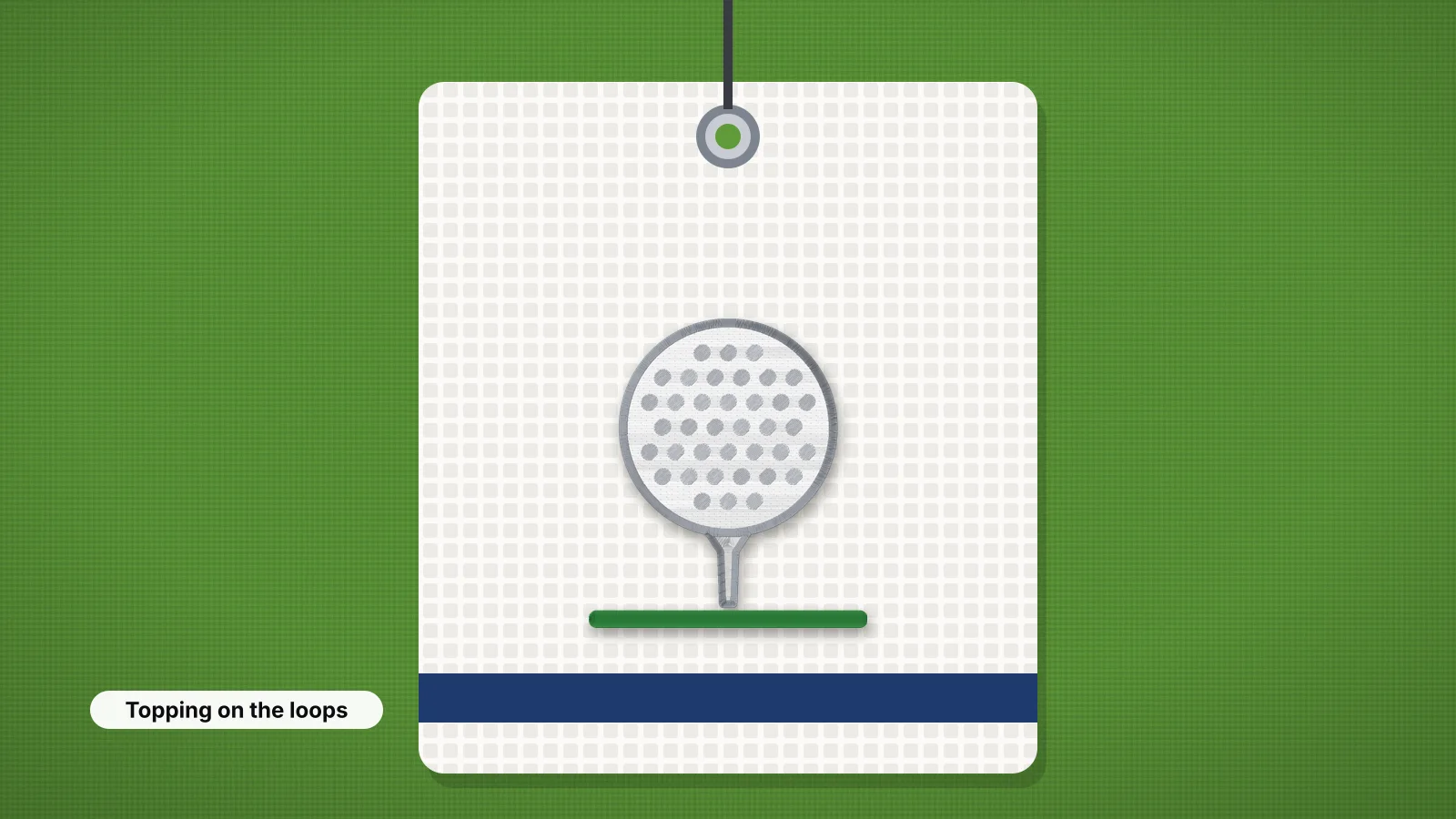
A golf towel hangs on the bag all the way round the course, so it's one of the most visible things a golfer owns: a good place for initials, a name, a club logo or a tournament date. It's also a towel, with pile or a waffle texture that swallows small stitches, and a grommet or clip that gets in the way of the hoop.
This guide covers golf towel types, where the design goes so it shows on the bag, sizes, topping and hooping, lettering and logos, and a matching polo. For towels in general, see how to embroider towels.
Waffle, terry and microfiber golf towels
| Towel | What it's like | For embroidery |
|---|---|---|
| Waffle weave | A grid of small square pockets; light and quick-drying | Use a topping: the pockets break up thin satin and small text |
| Terry (cotton loops) | Looped pile, often with a flat woven border | Always use a topping; the border band sews most crisply |
| Velour or sheared terry | Loops cut short for a smooth face | Sews more crisply than looped terry, but still use a topping |
| Microfiber | Soft, thin and often a little stretchy | Cut-away or no-show mesh underneath, and a topping on plush microfiber |
| Tri-fold with a grommet | Folded in three and hung from a grommet and clip | Stitch the panel that shows when folded; keep the grommet out of the hoop |
Check where the towel hangs before you choose a placement. Some hang from a corner grommet, some from the middle of one end, and some from a clip through the fabric.
Where the design goes
- Above the hem on the lower end. The most common spot: centered on the end that hangs down, about 1–2 in (25–50 mm) above the hem or border band, reading the right way up when the towel hangs.
- In the corner. A small initial or logo in the corner that hangs lowest, about 1.5–2 in (40–50 mm) in from each edge.
- On the border band. On terry towels with a flat woven band, lettering inside the band sews crisply. Keep a few millimeters clear at each edge.
- On the outside panel of a tri-fold. Fold it the way it hangs and mark the center of the panel that faces out.
Clip the towel to a bag or a hanger, then mark the center line and the bottom of the design with a water-soluble pen. A design centered on the flat towel can end up sideways or hidden in a fold.
Try it with your own design
Sign up free, upload an image and get a stitch preview in under a minute.
Drop your image here
PNG, JPG, WebP or SVG · stays on your device
Golf towel embroidery sizes
| Towel | Typical size | Design size |
|---|---|---|
| Small or pocket towel | Often about 12 × 16 in (30 × 40 cm) or less | About 2–2.5 in (50–65 mm) wide |
| Standard golf towel | Often about 16 × 24 in (40 × 60 cm) | About 2.5–4 in (65–100 mm) wide |
| Tri-fold towel | Often about 16 × 24 in, folded in three | About 2.5–3.5 in (65–90 mm), inside the outside panel |
| Large caddy or tour towel | Often about 20 × 40 in (50 × 100 cm) or more | About 4–6 in (100–150 mm) wide |
Sizes vary by maker, so measure. Names and logos grow wide fast; check the width against your hoop with the hoop size calculator. The hand towel size page covers similar small towels.
Topping, backing and hooping
- Topping on top. A water-soluble topping over waffle, terry and plush microfiber keeps stitches on the surface instead of sinking into the pockets or loops. Tear the excess away and dab off the rest afterwards.
- Backing underneath. Tear-away keeps the back neat on terry and waffle, where both sides show; cut-away or no-show mesh holds better on thin or stretchy microfiber.
- Float thick towels. Hoop sticky stabilizer on its own and press the towel on top, or use a magnetic hoop, so the rings don't crush the pile. A basting stitch round the design stops it shifting.
- Take off the clip and keep the grommet out of the hoop and well clear of the stitch path. A needle that hits a grommet breaks.
- Use a 75/11 or 80/12 sharp needle, or a ballpoint on stretchy microfiber.
The towel stabilizer page has the full setup, and the topping entry explains how it works.
Initials, names and club logos
- Initials and monograms suit the corner or the lower end. A three-letter monogram about 2–3 in (50–75 mm) tall reads well, and monogram letter order explains which initial goes where.
- Names in block capitals or a bold script, at least about 10–15 mm tall, hold up in waffle and terry. Thin serifs and hairline scripts disappear into the texture.
- Club and event logos need simplifying: fewer colors, no tiny text and no lines thinner than about 1 mm. A tournament name and year under the logo is a popular addition.
- Fill over wide satin. Large letters and shapes look best as fill on pile, because wide satin can sink between the loops.
Golf club and brand logos belong to their owners. Stitch them for the club, or with its permission; the copyright guide explains the basics.
Making the file
Upload the logo or initials to the digitizer, set the width and choose the Fleece, towel, sweatshirt preset. It adds heavy underlay to flatten the pile before the top stitches go on, a little more pull compensation and slightly denser satin. Check the stitch preview and the design check, which flags lettering under about 5 mm. Digitizing and previewing are free with an account; downloading the file needs a paid plan.
- Use polyester thread, which generally holds its color through hot washes better than rayon. Golf towels get wet and washed a lot.
- Test on a similar towel first. Waffle depth and pile height vary between makers.
- For a quick gift, the free golf ball design fits a 4×4 in hoop and downloads free with an account, and the golf embroidery ideas suggest more.
Practice on a free design
114 ready-to-sew designs in every machine format, free with an account.
A matching golf polo
Towels often go with polos for a club, a team or an event. A golf polo is a different job:
- Left chest, about 3–4 in (75–100 mm) wide; see the left chest size page.
- Performance knit needs no-show mesh or a light cut-away, a 70/10 or 75/11 ballpoint needle and gentle hooping; see the polo stabilizer page.
- The same logo, a different preset. Use the Stretch or Knit preset for the polo rather than the towel preset, so the density and pull compensation suit the fabric.
The polo shirt guide covers placement and hooping in full.