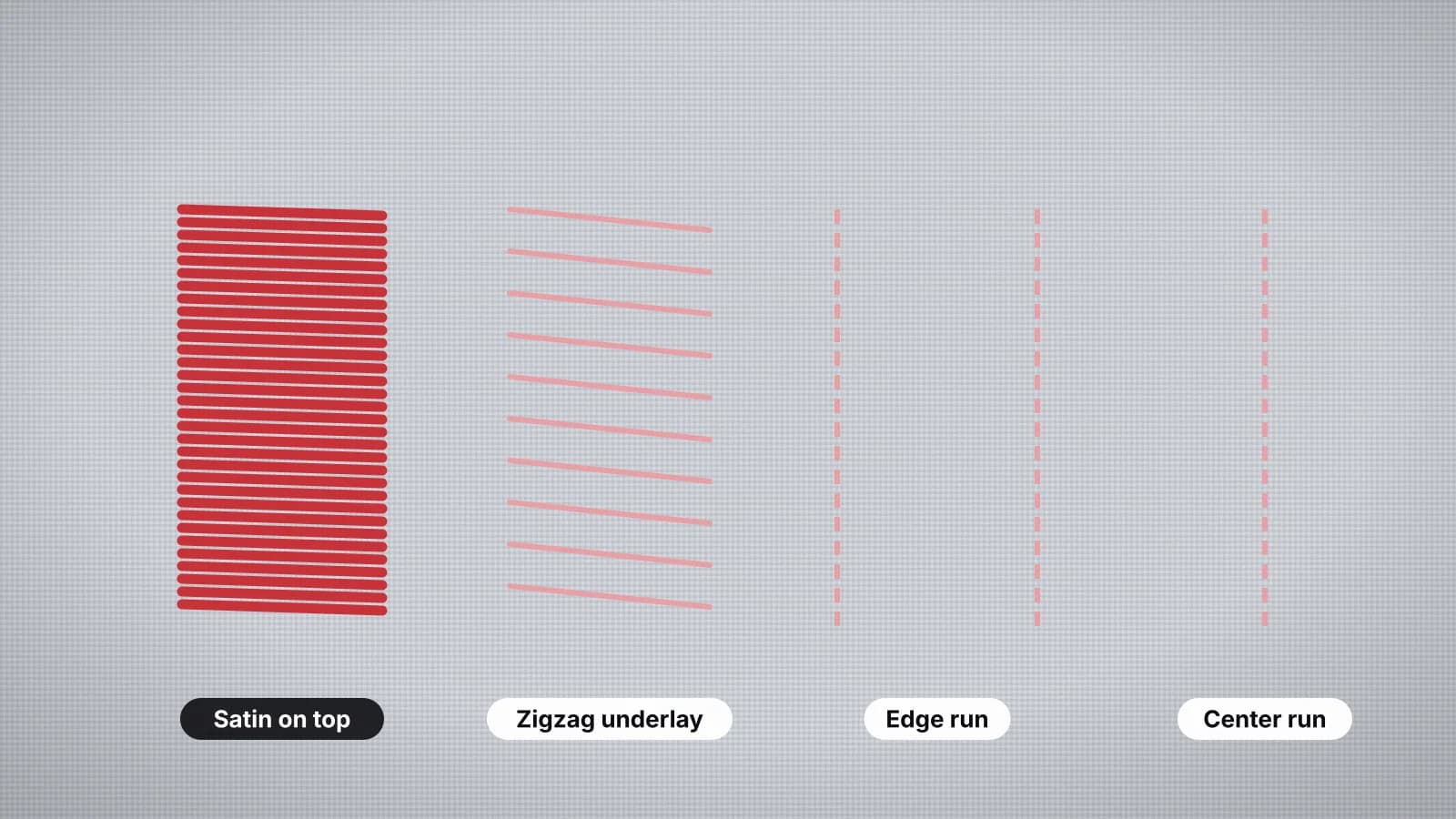
Turn a well-made design over, or watch one being stitched, and you'll see a framework of stitches that disappears under the top layer. That's underlay: the foundation every fill and satin column is built on.
Get it right and the design sits up crisp and flat; get it wrong and the fabric shows through, edges go ragged or small lettering turns lumpy. This guide explains each type of underlay, what it does, how much each fabric needs and how Embrizo plans it for you.
What underlay does
- Anchors the fabric to the stabilizer before the top stitches start pulling, so the design doesn't shift or pucker.
- Lifts the top stitches, so satin and fill sit on the surface instead of sinking into the fabric, especially on pile and knits.
- Covers the fabric, so it doesn't peek through the top stitches on contrasting colors.
- Gives clean edges, by holding the outline of a shape in place before the top stitching covers it.
- Reduces pull, since fabric that's already stitched down moves less. It works with pull compensation to stop gaps.
Underlay is sewn first, in the same thread as the shape on top, and is completely covered by it. Its stitches are long and open compared with the top stitching, so it adds support without adding much stiffness.
The main types of underlay
| Type | What it looks like | Used under | What it's for |
|---|---|---|---|
| Center run | One line of running stitch down the middle of a column | Narrow satin, such as small lettering and fine borders | Anchoring without bulk |
| Edge run | Running stitch just inside the edges of a shape | Medium satin columns, and around fills | Holding the outline for crisp edges |
| Zigzag | An open zigzag inside a column, often over edge runs | Wide satin columns | Lifting the satin and covering the fabric |
| Fill or tatami underlay | A light, open fill at an angle to the top fill, often at right angles | Large tatami fills | Steadying the area and giving the fill a smooth base |
| Double layers | Two passes at crossing angles, such as a double zigzag or two light fills | Wide or large areas on soft fabric | Extra lift and support, at the cost of more stitches |
Names vary a little between programs, but these are the building blocks, and many shapes combine two of them, such as edge runs topped with a zigzag.
Try it with your own design
Sign up free, upload an image and get a stitch preview in under a minute.
Drop your image here
PNG, JPG, SVG, PDF or AI · stays on your device
Not sure what to expect? See real examples or how it works.
Underlay under satin and under fill
- Satin columns get underlay by width: a center run for narrow columns, edge runs for medium ones, and edge runs plus a zigzag for wide ones. Too much underlay in a narrow column makes it lumpy and rounded.
- Fills usually get an edge run just inside the shape, then a light fill at an angle to the top stitches, so the top rows lie across the underlay rather than dropping into it.
- Small shapes get little or none: a tiny dot or a fine outline has no room for it, and running stitch outlines need none.
Satin stitch vs fill stitch explains when each top stitch is used, and the fill stitch and satin stitch entries define them.
How much underlay each fabric needs
| Fabric | Underlay | Why |
|---|---|---|
| Stable wovens: twill, canvas, denim | Standard | The fabric holds its shape, so underlay mainly gives a clean base |
| Knits: T-shirts, polos | Heavy | Knits stretch and let stitches sink between the loops |
| Stretch and performance fabric | Heavy | The fabric moves the most under the needle |
| Fleece, towels, sweatshirts | Heavy, plus a water-soluble topping | Pile swallows stitches unless they're lifted and the pile is held down |
| Leather and vinyl | Light | Every needle hole is permanent, so fewer stitches is better |
Underlay works with the stabilizer, not instead of it. The stabilizer guide and the stabilizer finder match the backing to the fabric, and a topping keeps stitches on top of towels and fleece.
Embrizo's four underlay levels
The Embrizo digitizer adds underlay to every fill and satin column automatically, at one of four levels you can set in the Stitches panel. The fabric preset picks one for you: Standard for Woven, Heavy for Knit, Stretch and fleece, and Light for leather.
| Level | Under satin columns | Under fills |
|---|---|---|
| None | No underlay | No underlay |
| Light | A center run, with a zigzag only on wide columns, about 4 mm and up | An edge walk just inside the shape, with no fill underlay |
| Standard | A center run under about 1.8 mm, edge runs above that, and edge runs plus a zigzag from about 3.5 mm | An edge walk, then one light fill at right angles to the top stitches |
| Heavy | Edge runs from about 1.2 mm, and edge runs plus a zigzag from about 2.5 mm | An edge walk, then two light fills at crossing angles on larger areas |
The edge walk sits about 0.5 mm inside the edge, so the top stitches hide it, and very small fills get less underlay or none. Try Heavy on soft or lofty fabric, or Light for small lettering on a stable woven if it looks lumpy. Digitizing and previewing are free with an account, so you can compare levels in the preview before you download with a plan.
Practice on a free design
167 ready-to-sew designs in every machine format, free with an account.



Signs of too much or too little underlay
| What you see | Likely cause | Fix |
|---|---|---|
| Fabric showing through a fill or satin | Too little underlay for the fabric, or none | A heavier level, plus a topping on pile |
| Stitches sinking into a towel or fleece | Too little lift | Heavy underlay and a water-soluble topping |
| Ragged or wavy edges | Nothing holding the outline | A level that adds edge runs, such as Standard or Heavy |
| Small lettering lumpy or rounded | Too much underlay in narrow columns | A lighter level, or bigger lettering |
| A design stiff as a board | Heavy underlay and a dense fill on a light fabric | Lighter underlay or a lighter fill density |
Change one thing at a time and test on scrap. The density guide explains how underlay and density add up, and how to fix puckering covers stiff, rippled designs.