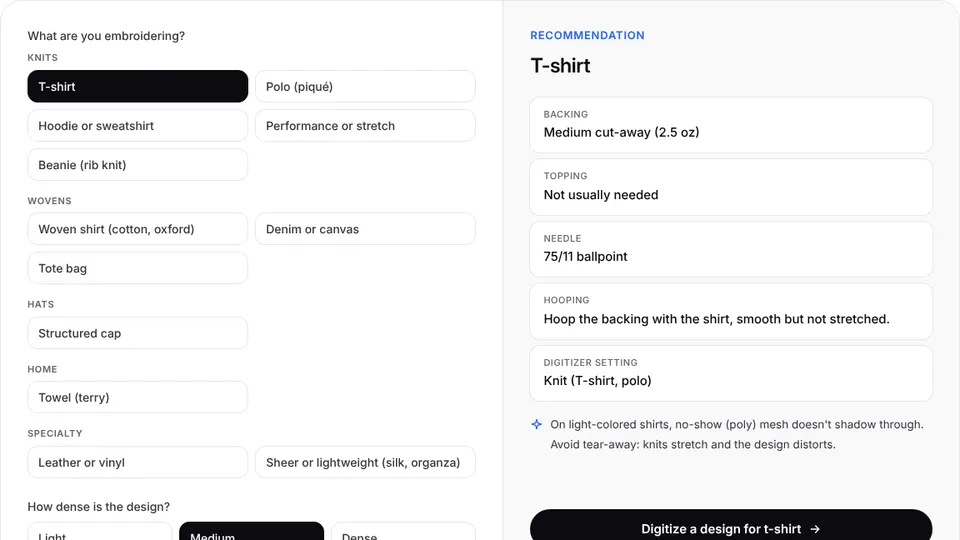
 Free toolStabilizer finderPick the fabric and design density to get the right backing, topping, needle and hooping.Open the tool
This checklist is for anyone who has just bought an embroidery machine, or is about to, and wants to know what else to buy. It sorts every supply into must-have, nice-to-have and later, with rough 2026 prices in US dollars, so you buy enough for your first projects without filling a cupboard.
It applies to single-needle home machines from Brother, Baby Lock, Janome, Bernina, Singer and others. The machine itself is covered in how much an embroidery machine costs; this guide is everything around it.
What supplies do you need for machine embroidery?
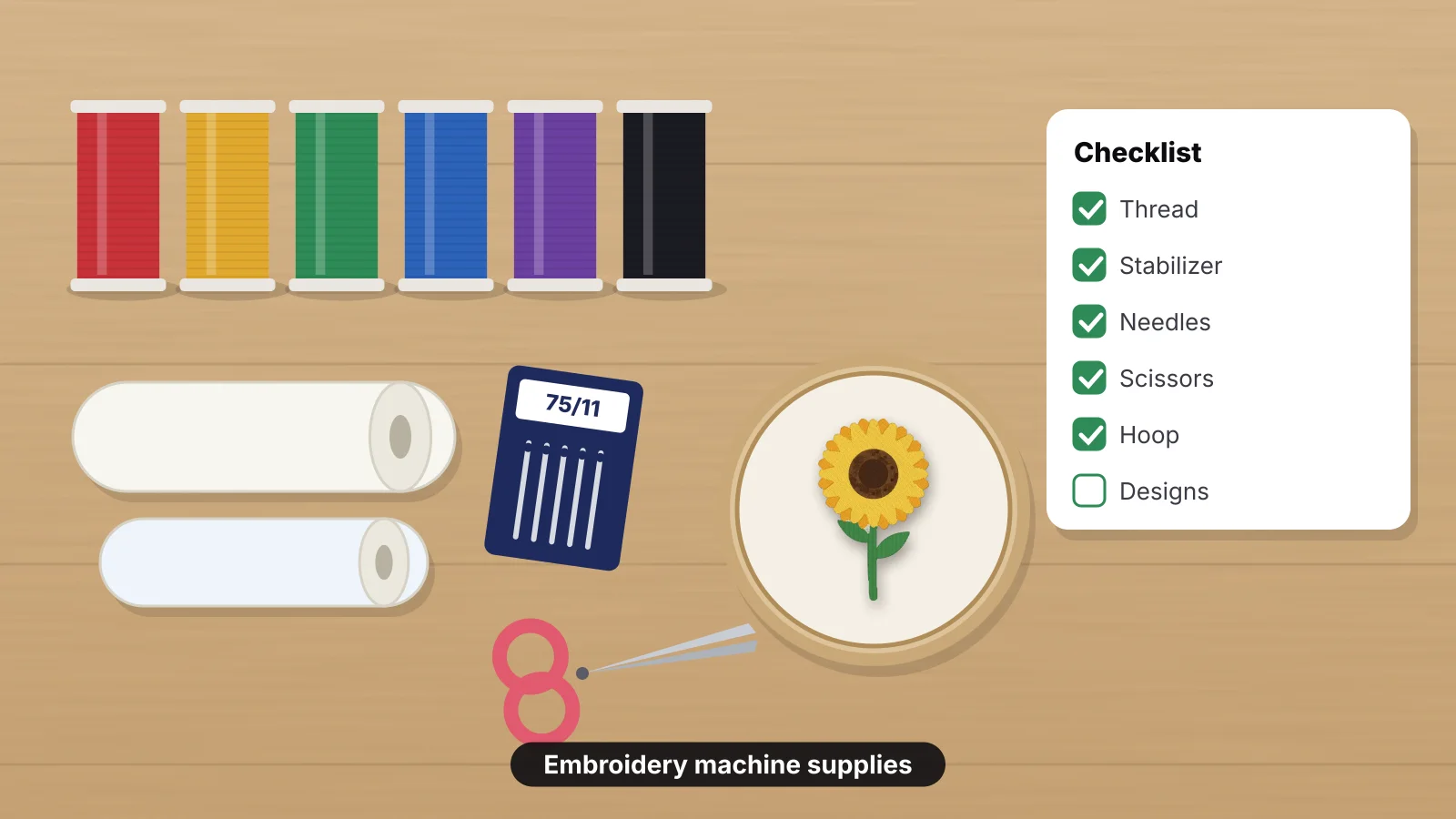
You need thread, bobbins, needles, stabilizer, something to cut threads, something to mark placement and a way to get designs onto the machine. Everything else makes the work faster or neater and can wait until you know what you'll embroider most.
| Supply | Priority | What to get | Rough cost |
|---|---|---|---|
| Embroidery thread | Must-have | A 40-spool kit of 40 wt polyester, or 10–15 brand-name spools in basic colors | About $25–$40 a kit; $3.50–$6 a spool |
| Bobbins | Must-have | Prewound bobbins in white, plus black for dark fabric, in the size your manual names | About $20–$50 for 144 |
| Embroidery needles | Must-have | 75/11 sharp, 75/11 ballpoint and a pack of 90/14 | About $5–$8 for 5 |
| Tear-away stabilizer | Must-have | Medium weight, for woven cotton, canvas and denim | About $13–$21 for 12 in × 10 yd |
| Cut-away stabilizer | Must-have | Medium weight or no-show mesh, for T-shirts, polos and sweatshirts | About $15–$30 a roll |
| Water-soluble topping | Must-have for towels and fleece | A clear film that keeps stitches above the pile | About $10–$25 a roll |
| Curved thread snips | Must-have | Small spring snips with a curved tip | About $3–$25 |
| Marking pen | Must-have | A water-soluble pen or chalk for center marks | About $4–$8 |
| USB stick | Must-have for most machines | A small stick formatted FAT32 | About $5–$10 |
| Designs | Must-have | Free designs, bought files or your own artwork digitized | From free to about $50 a design |
| Sticky stabilizer | Nice-to-have | Peel-and-stick tear-away for floating caps, collars and small pieces | About $16–$25 for 6 yd |
| Temporary spray adhesive | Nice-to-have | A spray such as Odif 505 to hold fabric to the backing | About $14–$20 a can |
| Double-curved scissors | Nice-to-have | For trimming jump threads and appliqué close to the stitches | About $10–$15 |
| Seam ripper and tweezers | Nice-to-have | For unpicking mistakes and pulling thread tails | About $5–$15 |
| Thread stand | Later | Holds large cones behind a single-needle machine | About $8–$36 |
| Thread cones | Later | About 5,000 m cones of black, white and your most used colors | About $13–$20 a cone |
| Extra hoops | Later | The next size up, or a small hoop for little items | Varies by brand and size |
| Magnetic hoop | Later | Clamps thick or awkward items without forcing a ring over them | About $100–$300 |
| Digitizing software or a service | Later | For your own logos, names and artwork | Software from free to about $1,200; a service about $10–$50 a design |
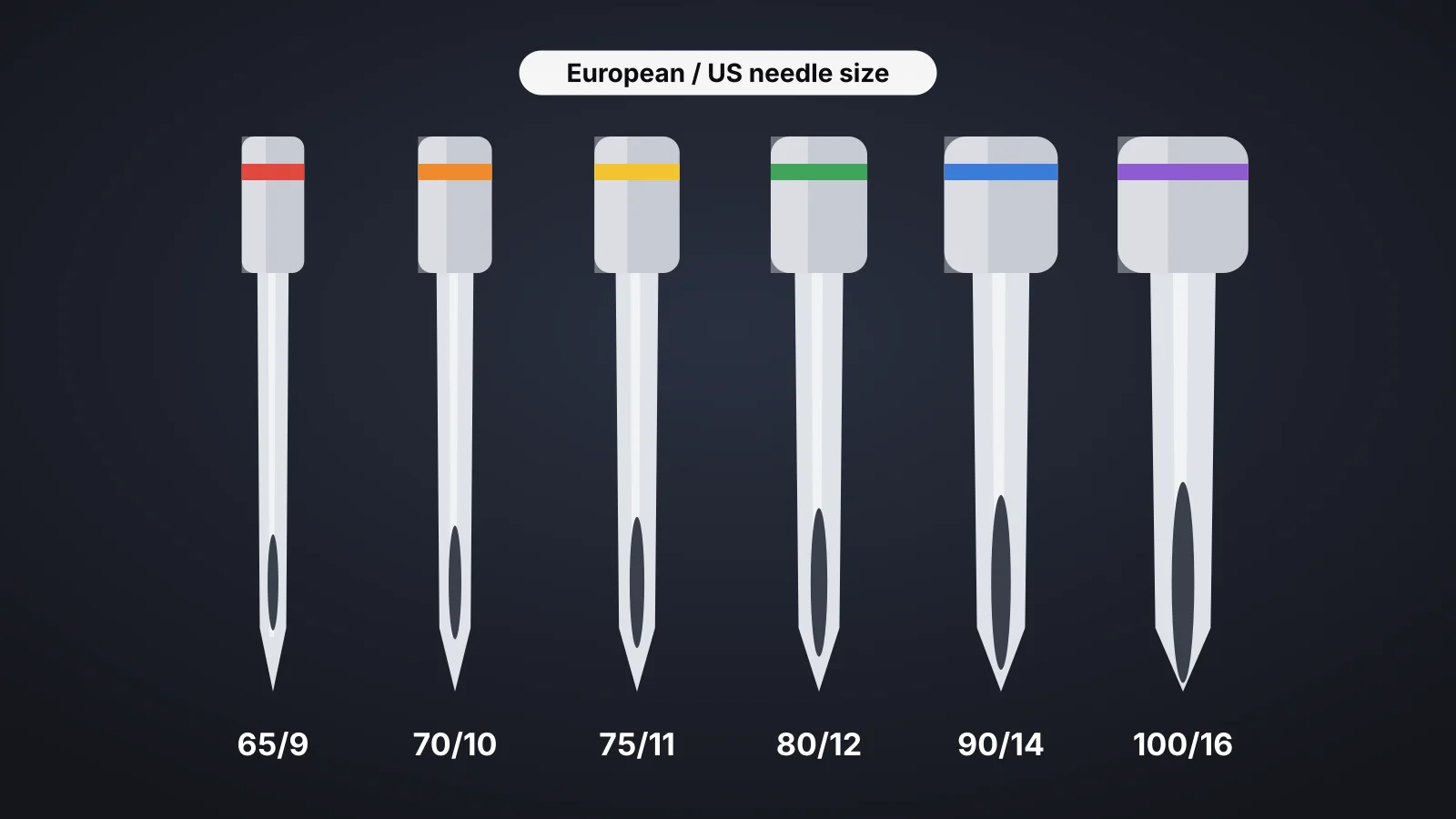
The stabilizer finder and the needle size chart tell you which backing and needle each fabric needs, so you only buy the ones your projects call for.
Which embroidery thread should you buy first?
Buy 40-weight polyester embroidery thread first, as a 40-spool kit or as 10–15 brand-name spools in the colors you'll use most. Most designs are digitized for 40 wt, and polyester is strong and colorfast enough for clothes that are washed often.
| Thread | What it's for | Buy it |
|---|---|---|
| 40 wt polyester | Almost everything: logos, names, fills and lettering | Now |
| Bobbin thread, about 60–90 wt | The underside of every design, in white or black | Now |
| 40 wt rayon | The highest sheen, for items washed gently | If you like the look; it's less colorfast than polyester |
| 60 wt polyester | Lettering under about 5 mm and fine detail, with a 65/9 or 70/10 needle | When you start stitching small names |
| Metallic | Accents, with a metallic or topstitch needle and a slower speed | Later, for holiday and special projects |
A kit is the cheapest way to get a range of colors: a 40-spool kit of 40 wt polyester typically costs about $25–$40, depending on whether the spools hold 500 m or 1,000 m. Brand-name threads such as Isacord, Madeira and Brother's own embroidery thread cost about $3.50–$6 for roughly 1,000 m, and are easier to reorder in exactly the same shade. Many embroiderers start with a kit and later buy cones of black, white and the colors they use most.
Prewound bobbins save time and wind evenly. Class 15 and Style L bobbins look alike but differ in thickness, so buy the size your manual names. The thread guide compares fibers and shows how far a spool goes, the thread weight guide explains 30, 40 and 60 wt, and the thread color chart lists Brother and Janome codes for building a starter palette.
Try it with your own design
Sign up free, upload an image and get a stitch preview in under a minute.
Drop your image here
PNG, JPG, SVG, PDF or AI · stays on your device
Not sure what to expect? See real examples or how it works.
Which needles do you need for an embroidery machine?
Start with 75/11 embroidery needles in two points: a sharp for woven fabric and caps, and a ballpoint for T-shirts, polos and sweatshirts. Add a pack of 90/14 for denim, canvas and thick layers, and fit a new needle every 8–10 hours of stitching.
| Needle | Use it for | Thread |
|---|---|---|
| 75/11 sharp | Cotton, linen, canvas, twill, caps and towels | 40 wt |
| 75/11 ballpoint | T-shirts, polos, sweatshirts and other knits | 40 wt |
| 65/9 or 70/10 | Fine fabric and small lettering | 60 wt |
| 80/12 or 90/14 sharp | Denim, canvas, heavy jackets and several layers | 40 wt or 30 wt |
| Titanium-coated | Long runs and sticky stabilizer, where plain needles gum up | 40 wt |
| Metallic or topstitch | Metallic thread, which needs a larger eye | Metallic |
Embroidery needles have a larger eye and a shape that protects thread at speed, so they shred and break less than universal sewing needles. Packs of five 75/11 embroidery needles from makers such as Schmetz and Organ typically cost about $5–$8, and titanium needles more. Most home embroidery machines take flat-shank needles in the 130/705 H system, while most commercial multi-needle machines use round-shank DBxK5 needles, so buy the system your manual lists. The needle guide has the full chart.
Which stabilizers should you start with?
Start with three: a medium tear-away for woven fabric, a medium cut-away or no-show mesh for knits, and a water-soluble topping for towels and fleece. That covers nearly every first project, and rolls of each typically cost about $10–$30.
| Fabric | Backing | Topping | Add later |
|---|---|---|---|
| Woven cotton, linen, canvas, denim | Tear-away | Not needed | Heavier tear-away for dense designs |
| T-shirts, polos, sweatshirts | Cut-away or no-show mesh | Only on piqué and textured knits | Fusible no-show mesh |
| Towels and fleece | Tear-away or cut-away | Water-soluble, always | A second layer of backing for dense designs |
| Unstructured caps | Firm tear-away, or sticky tear-away floated | Not needed | Tear-away made for caps |
| Collars, cuffs and small pieces | Sticky tear-away, floated | Not needed | Spray adhesive |
| Sheer fabric and lace | Wash-away | Optional | Heavy wash-away film when you make free-standing lace |
| Leather and vinyl | Tear-away or cut-away | Not needed | Sticky stabilizer, floated, so no hoop ring marks it |
Buy rolls wide enough to cut a piece about 1 in (25 mm) bigger than the hoop on every side; 12 in rolls cover most hoops up to 5 × 7 in. A 12 in × 10 yd roll of tear-away typically costs about $13–$21, and peel-and-stick versions more, such as about $16–$25 for 6 yd of Sulky Sticky+. The stabilizer guide explains each type, and the stabilizer finder gives the backing, topping, needle and hooping for a fabric and design density.
Spray the stabilizer, not the fabric, and do it away from the machine. A can of temporary spray such as Odif 505 typically costs about $14–$20, and overspray gums up needles and the bobbin area.
Which cutting, marking and hooping tools do you need?
You need curved snips and a marking pen from day one. Double-curved scissors, tweezers, a seam ripper, extra hoops and a magnetic hoop make the work faster once you embroider often.
- Snips and scissors. Spring snips with a curved tip, about $3–$25, cut jump threads and tails between colors. Double-curved embroidery scissors, such as Havel's 3.5 in pair at about $10–$15, trim close to the stitches without catching the fabric, and appliqué needs them.
- Seam ripper and tweezers. For unpicking a mistake from the back and pulling out thread tails and stray bits of tear-away.
- Marking. A water-soluble pen or tailor's chalk for a center cross, plus a ruler. The placement template prints a design at true size with crosshairs, and the hoop template prints your hoop's sewing area.
- Extra hoops. The hoop that came with the machine covers most first projects. The next standard size up and a small hoop for little items are the first to add; buy your brand's hoops or ones listed for your exact model.
- Magnetic hoops. A magnetic hoop clamps the fabric between a frame and magnets, which is quicker and kinder to thick towels, bags and velvet than a screw hoop. For home machines they typically cost about $100–$300, such as Brother's 4 × 4 in SAMFM100 and DIME's Snap Hoop Monster. The magnets are strong, so mind your fingers and follow the maker's safety warnings.
- A thread stand. A cone stand, about $8–$36, lets a single-needle machine run 5,000 m cones, which cost less per meter than spools.
Embroidery hoop sizes explains sewing fields and which hoop fits which design.
How much does a starter embroidery supply kit cost?
About $115–$200 buys the must-haves for a single-needle home machine in 2026, and about $160–$275 adds sticky stabilizer, spray adhesive and better scissors. A magnetic hoop and digitizing software are the big optional costs.
| Item | Starter kit | With nice-to-haves |
|---|---|---|
| Thread: a 40-spool 40 wt polyester kit | $25–$40 | $25–$40 |
| Prewound bobbins, 144 | $20–$35 | $20–$35 |
| Needles: 75/11 sharp, 75/11 ballpoint, 90/14 | $15–$24 | $15–$24 |
| Stabilizer: tear-away, cut-away, water-soluble topping | $40–$70 | $40–$70 |
| Snips, marking pen and USB stick | $14–$33 | $14–$33 |
| Sticky stabilizer and spray adhesive | Not yet | $30–$45 |
| Double-curved scissors, seam ripper and tweezers | Not yet | $15–$30 |
| Total | About $115–$200 | About $160–$275 |
- Later, as you need them: a magnetic hoop at about $100–$300, cones at about $13–$20 each, a thread stand at about $8–$36 and extra hoops for your machine.
- Designs and digitizing: free and bought designs cost little; your own logos need digitizing, by a service at about $10–$50 a design, software from free to about $1,200, or an online digitizer.
- Upkeep: a home machine tune-up typically costs about $100–$200, and many dealers suggest one a year.
Once you're set up, supplies are a small cost per piece: thread, backing and needle wear for a left chest logo come to well under $0.50. The thread calculator estimates thread per design and per order from a stitch count or a file.
Practice on a free design
167 ready-to-sew designs in every machine format, free with an account.
Where do designs come from, and how do they get to the machine?
Designs come from three places: the ones built into your machine, ready-made files you download or buy, and your own artwork digitized into a stitch file. Most home machines load them from a USB stick in their own format, such as PES for Brother and Baby Lock or JEF for Janome.
- A USB stick. A small stick formatted FAT32 works on most machines. Some, such as the Brother PE800, read only the top level of the stick, not folders, and Janome gives 16 GB as the largest stick for the Memory Craft 500E, so check your manual.
- Free designs. Embrizo has over 100 free designs, all original, in PES, DST, JEF, EXP, VP3 and XXX; they're free with an account, and many fit a 4 × 4 in hoop.
- Bought designs. Design shops and Etsy sellers sell files, often for a few dollars each. Buy the format your machine reads, or change it with the file converter.
- Your own artwork. Logos, names and drawings need digitizing: by a service, in desktop software such as the free Ink/Stitch, or with an online auto-digitizer.
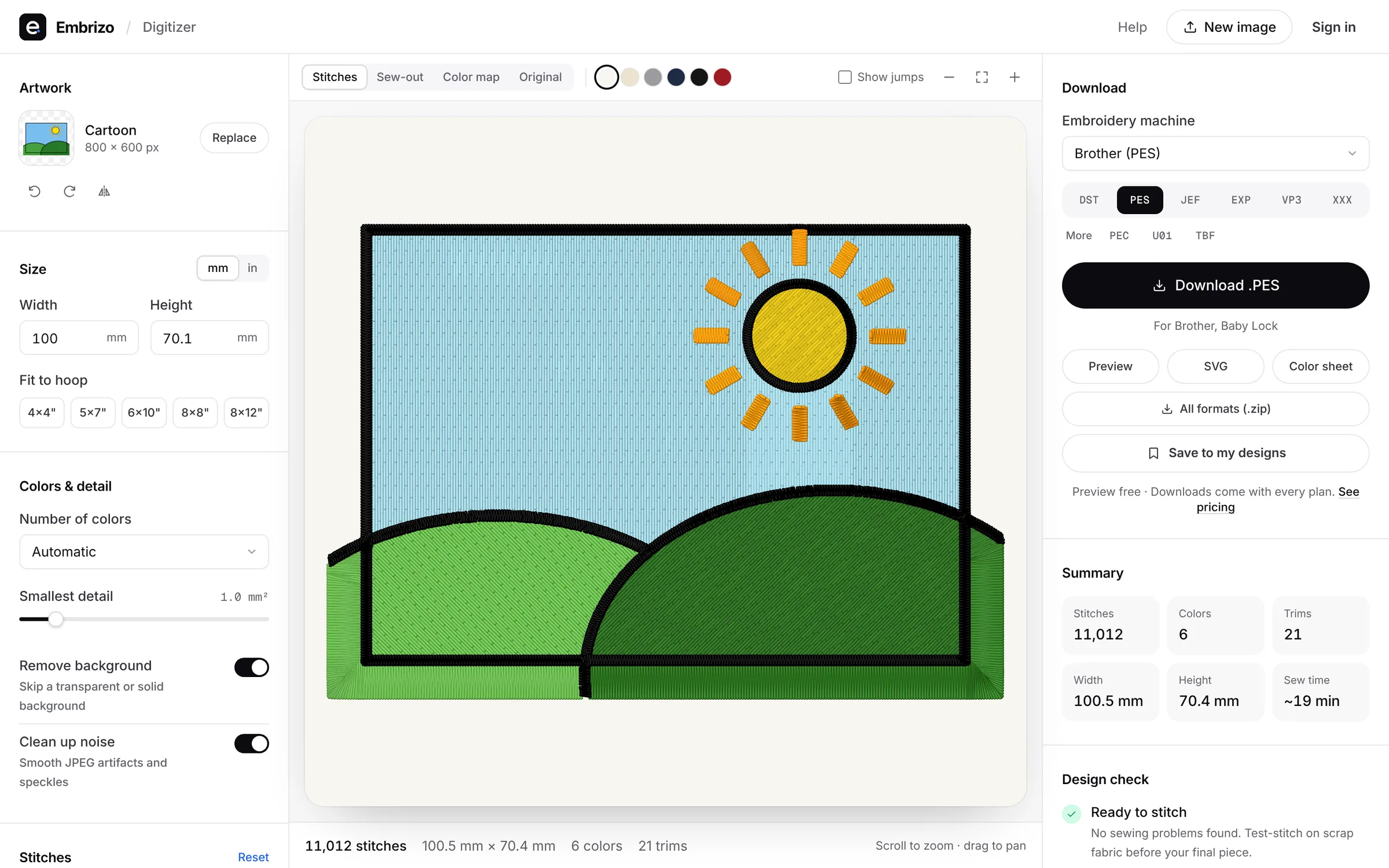
With Embrizo, you upload a PNG, JPG, SVG, PDF or Illustrator file to the digitizer, set the width for your hoop, pick the fabric preset and check the stitch preview and design check. It chooses satin, fill or running stitch for each shape, adds underlay, pull compensation and lock stitches, matches Brother or Janome threads and writes PES, JEF, DST, EXP, VP3, XXX and other formats. It doesn't replace a test sew-out, and photos are simplified into a few flat colors. Digitizing and previews are free with an account; downloading files needs a plan.