 Free toolStabilizer finderPick the fabric and design density to get the right backing, topping, needle and hooping.Open the tool
Matching robes with Bride and Bridesmaid across the back are the getting-ready photo nearly every bridal party asks for, and a popular wedding order for embroiderers. They're also unforgiving: satin is slippery and marks under a hoop, the title is a long script word across the back, and a party of eight means eight names to spell right.
This guide covers sizes and placement, the backing and needle for satin, waffle and cotton, hooping satin without hoop burn, script fonts that stitch at robe sizes, thread colors, a batch workflow, a timeline and pricing. To lay out the designs as you read, open the bride and bridesmaid design maker.
 Free design makerBride and bridesmaid embroidery design makerType the name, pick lettering and an icon, and see it sized for the item. Then turn it into a file for your machine.Make yours
Where do the title and name go on a bridesmaid robe, and how big?
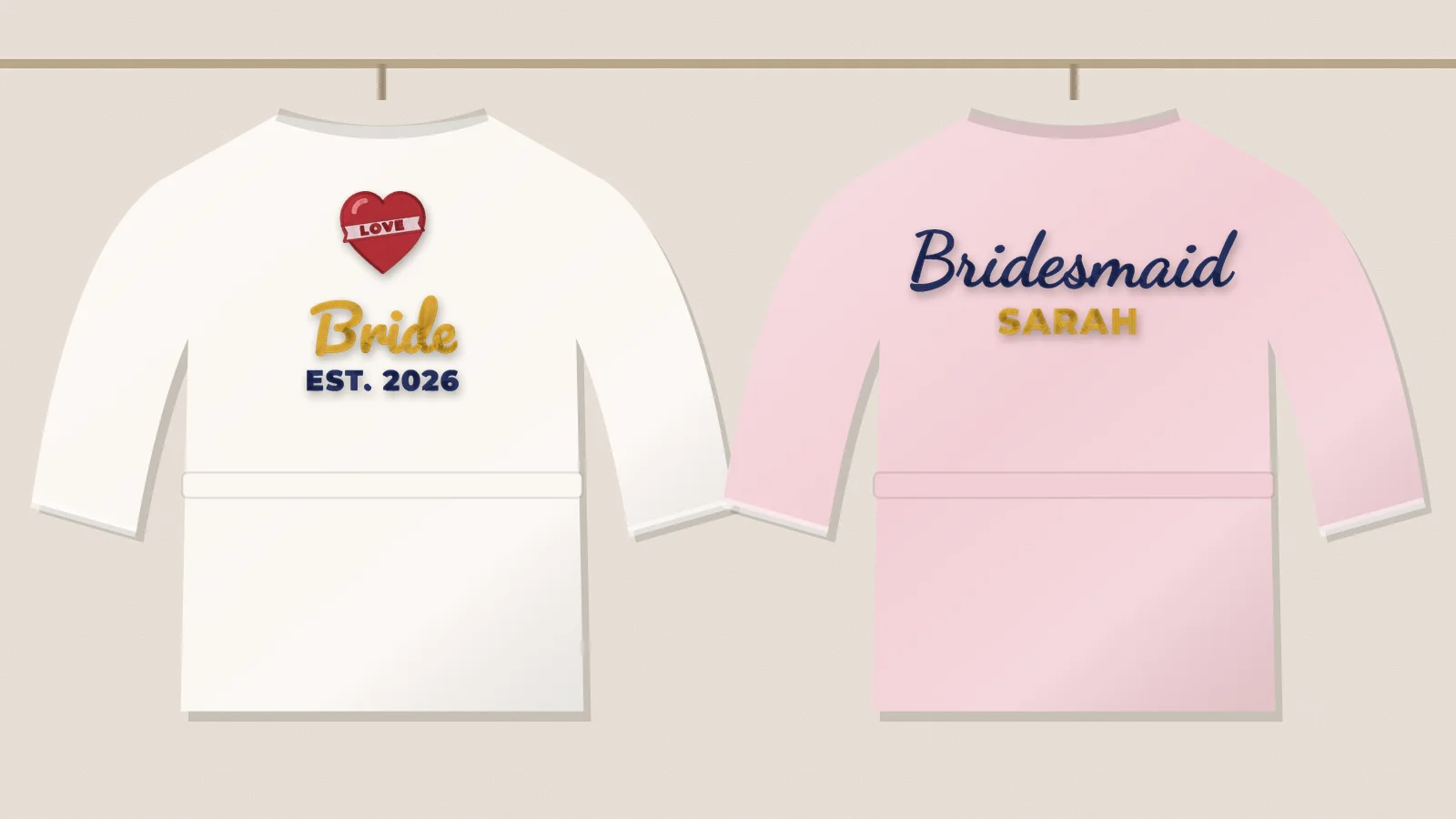
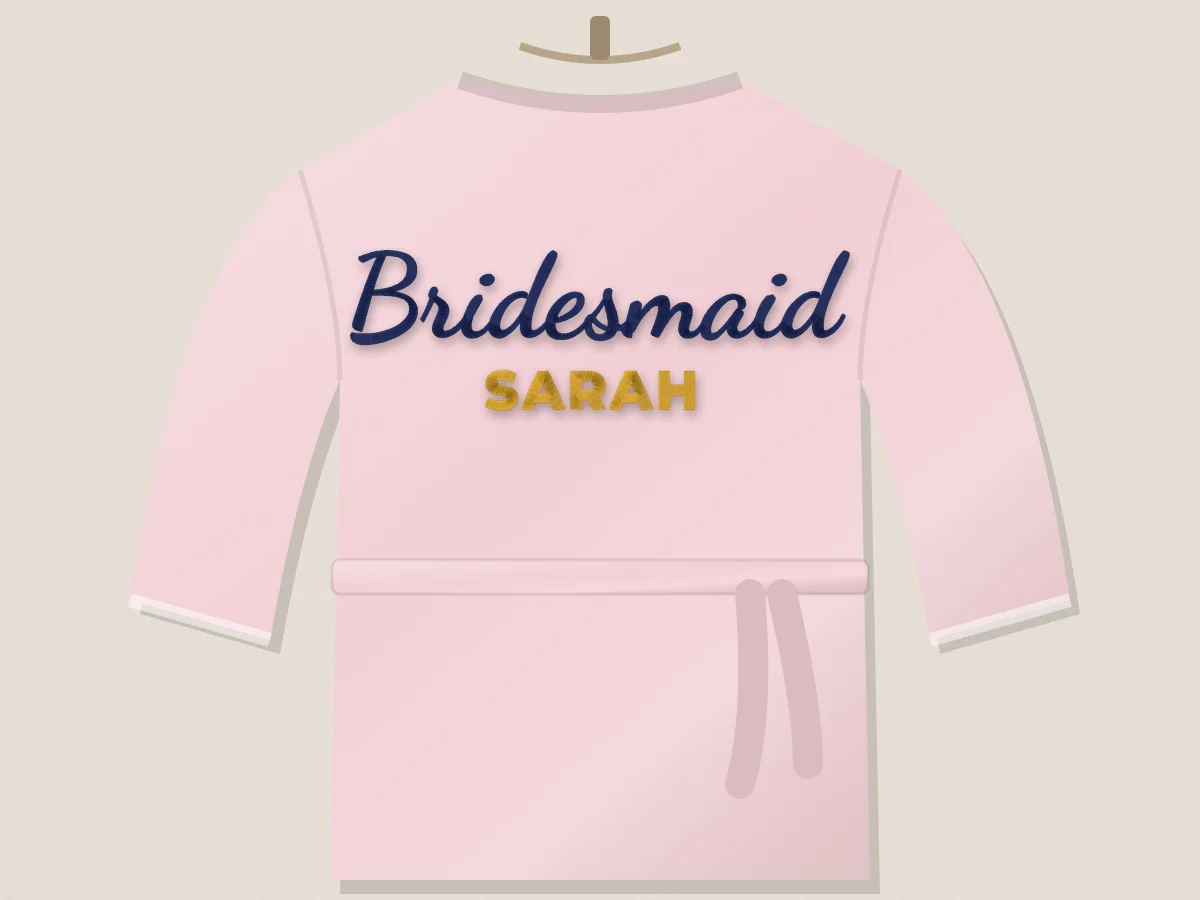
The classic layout puts the title in script across the upper back and the name or an initial on the left chest, so the robes match from behind in group photos and each one is personal from the front. Putting the name under the title instead needs only one hooping. Typical sizes on an adult robe:
| Element | Size, about | Where it goes |
|---|---|---|
| Back title: Bride | 8–9 in (200–230 mm) wide | Centered between the side seams, the top 4–5 in (100–125 mm) below the back neck seam |
| Back title: Bridesmaid, Maid of Honor | 10–11 in (250–280 mm) wide | The same spot; a long word sets the width, so its letters come out smaller |
| Name under the title | 2.5–4 in (65–100 mm) wide, lowercase at least 8 mm | About ½–¾ in (12–20 mm) below the title |
| Chest name or initial | A name 3–3.5 in (75–90 mm) wide; an initial 1.25–2 in (30–50 mm) tall | Left chest, between the collar band and the armhole, at shirt-pocket height |
| Flower girl robe | A back title 5–7 in (125–175 mm) wide | Scaled to the smaller back |
Mark the spots with chalk or painter's tape on a robe that's being worn, or tied on a hanger: the wrap hides more of the chest than you'd expect. If the party will wear their hair down, set the title about 6 in below the collar so it shows in back-view photos.
A title 8–11 in wide is bigger than most home embroidery fields, so your largest hoop sets the largest title. Turn the hoop sideways so the word runs along its long side, and rotate the design 90°:
| Hoop | Widest back title, about | What it suits |
|---|---|---|
| 5×7 (130 × 180 mm), turned | 6.75 in (174 mm) | Flower girl robes |
| 8×8 (200 × 200 mm) | 7.6 in (194 mm) | A short Bride on a petite robe |
| 6×10 (160 × 260 mm), turned | 10 in (254 mm) | Bride, and Bridesmaid at up to 10 in |
| 8×12 (200 × 300 mm), turned | 11.5 in (294 mm) | Every title, including Maid of Honor at 11 in |
| 9.5×14 (240 × 360 mm), turned | 13.9 in (354 mm) | Every title, with a name or date underneath |
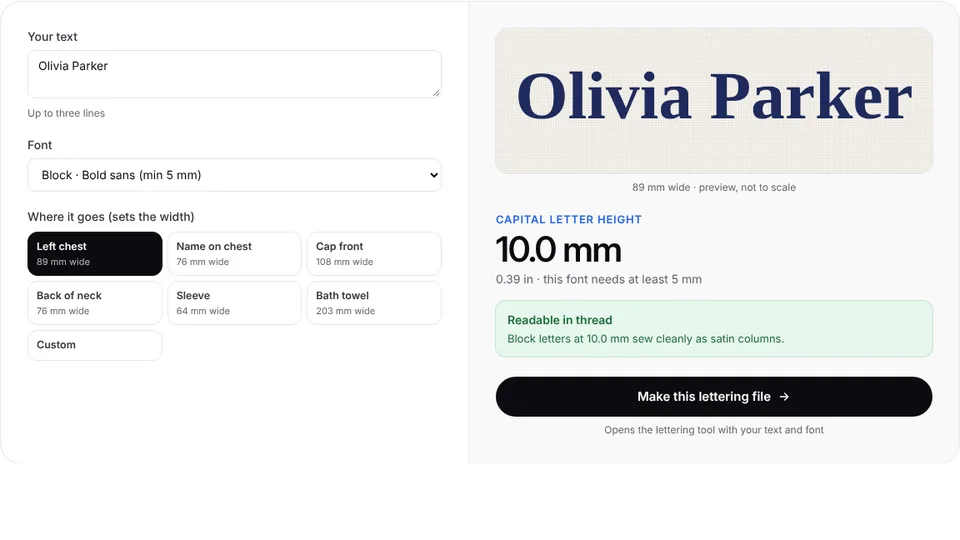
Splitting a title across two hoopings is hard on satin, which can mark at each one, so with a 5×7 a chest name alone often looks better. The bride and bridesmaid maker lays out the title and name at robe-back size, 10 in wide, or for a left chest, and checks the name line stays big enough to read.
Which robe fabrics embroider best, and which stabilizer does each need?
Satin, waffle and cotton cover most bridal party robes, and all need a backing that stays in: tear-away leaves the stitches unsupported on these light fabrics. Use cut-away or no-show mesh, a thin, soft cut-away that doesn't shadow through:
| Robe fabric | Backing | Topping | Needle | Digitizer preset |
|---|---|---|---|---|
| Polyester satin | Fusible no-show mesh, plus a second layer floated under a large back title | None | 70/10 microtex or 75/11 sharp | Woven |
| Waffle weave, cotton or cotton-poly | Medium cut-away (2–2.5 oz) or two layers of no-show mesh | Water-soluble, always | 75/11 sharp; ballpoint on a waffle knit | Fleece, towel, sweatshirt |
| Lightweight cotton or voile | No-show mesh | None | 75/11 sharp, 70/10 on voile | Woven |
| Terry or spa robes | Medium cut-away | Water-soluble, always | 75/11 or 80/12 sharp | Fleece, towel, sweatshirt |
- Satin is slippery and shows every pucker in its sheen. Fuse the mesh with a press cloth on the lowest setting that bonds it, after a test on the inside hem, since polyester satin can glaze under a hot iron.
- Waffle has deep cells that swallow thin stitches. The topping keeps the letters on the surface, and a script with thick strokes reads better than a fine one.
- Cotton can shrink, so wash and dry cotton and waffle robes first. On a busy print, pick a thread that contrasts with its main color.
Use white mesh under white, blush and pastel robes and black under dark ones, trimmed to about ¼ in (6 mm) around the stitches with rounded corners, since the inside shows whenever a robe falls open.
Buy one spare robe of each color. It's your test piece for backing, needle and thread, and it covers a late addition to the bridal party.
Try it with your own design
Sign up free, upload an image and get a stitch preview in under a minute.
Drop your image here
PNG, JPG, SVG, PDF or AI · stays on your device
Not sure what to expect? See real examples or how it works.
What needle and thread work on a satin robe?
Use a fine, sharp needle: a 70/10 microtex or a 75/11 sharp-point embroidery needle. The slim point pierces the tight weave instead of pushing threads aside, which avoids pulled lines and snags. The rest of the setup:
- Thread: 40 wt polyester, which holds its color through washing.
- Bobbin: white under light robes and black under dark ones, so nothing shows at the letter edges.
- Density: a touch lighter than on cotton, since a dense design pulls satin into shiny puckers. Fit a new needle for each batch; a burred point snags.
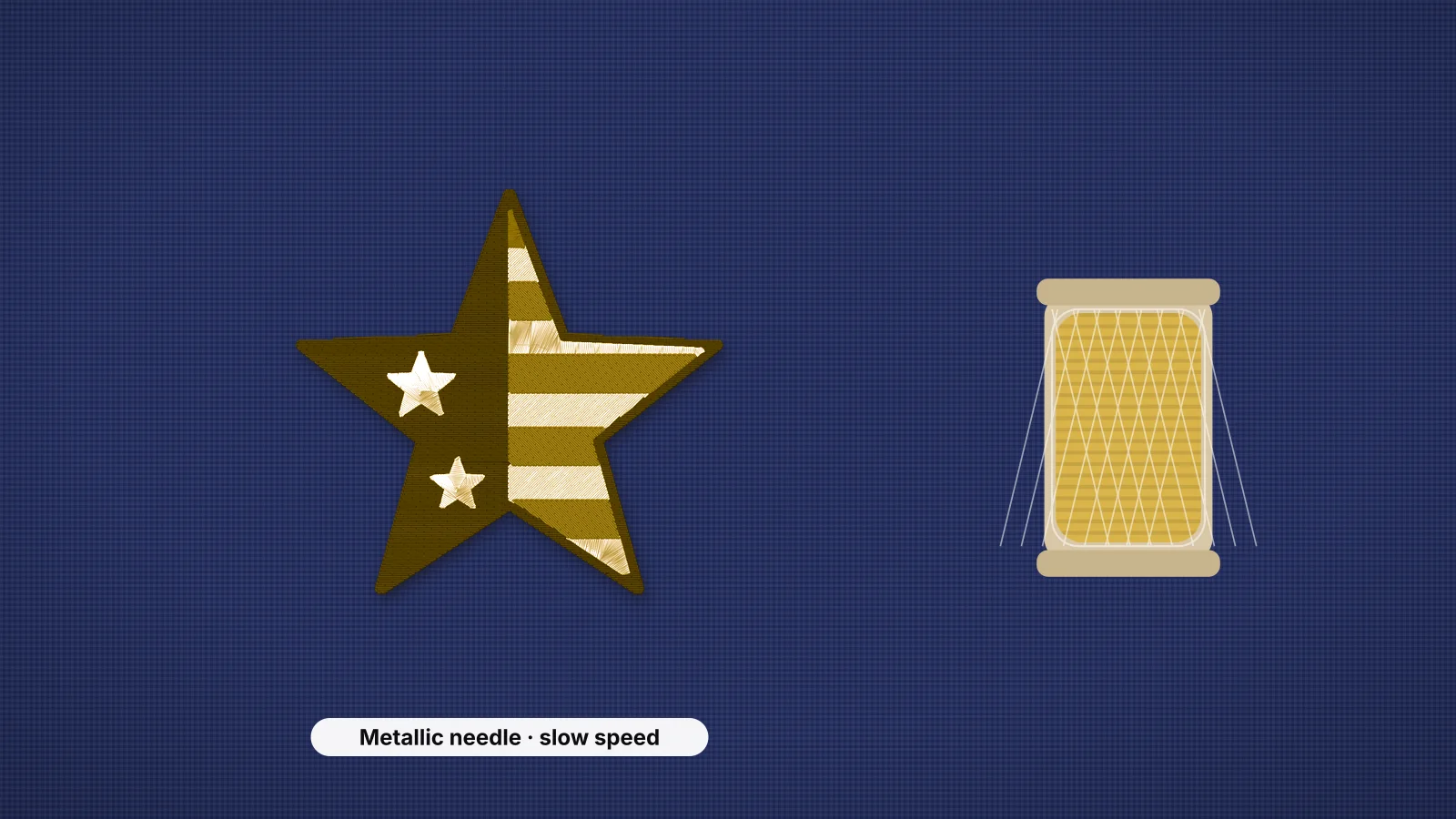
Metallic gold is the most-asked-for color and the hardest to sew. It needs a bigger eye than a microtex, usually a metallic needle in 80/12, a lower speed, a slightly looser top tension and a thread net on the spool; test on the spare robe, because needle holes don't close in satin. Metallic suits the back title, whose strokes are a comfortable 3–6 mm wide in a flowing script; for a small chest name, gold polyester sews like any other thread. The metallic thread guide has the details.
How do you hoop a satin robe without hoop burn?
Hoop burn is the shiny, crushed ring a hoop can leave on satin, and it doesn't always steam out. The safest approach keeps the hoop off the satin: hoop the stabilizer and float the robe on top.
- Lay the robe right side down and fuse no-show mesh, about 1 in (25 mm) bigger than the design all round, to the inside of the back.
- Turn it over and mark the center and a level line with chalk or painter's tape. Water can mark some satins, so test a water-soluble pen on the hem first.
- Hoop a sticky tear-away paper side up, score the paper and peel it off, or mist a hooped tear-away with temporary spray adhesive away from the machine.
- Smooth the robe onto it, right side up, with your marks on the hoop's center marks. Flat, not drum-tight.
- Fold the front panels, sleeves and belt away and clip them to the hoop. A robe opens flat, so only the back is in the hoop, but a loose sleeve can slide under the needle.
- Sew a basting box if your machine has one, after a test on the spare, since its holes can show on fine satin.
- After stitching, tear the tear-away off around the design and trim the fused mesh to about ¼ in (6 mm).
A magnetic hoop also works: it clamps the robe and its fused mesh without forcing satin between two rings. With a standard hoop, lay tissue paper over the satin before pressing the inner ring in, then tear a window over the design. Steam any mark from just above, never touching. Chest names go the same way in a 4×4 or 5×7, collar band outside the hoop.
Which script fonts stitch cleanly at robe sizes?
At back-title size almost any script works; what changes is how wide its strokes come out. A satin column sews best at about 2–5 mm and snags past about 7 mm, and a short word set wide gets big letters with wide strokes. Measured on Embrizo's Flowing style, a bold flowing script:
| Lettering | Capital height, about | The main strokes |
|---|---|---|
| Bride at 8–9 in (200–230 mm) | 2.75–3 in (70–80 mm) | About 7–10 mm, wider in a heavy script: sewn as fill or split satin |
| Bridesmaid at 10–11 in (250–280 mm) | 1.7–1.9 in (42–49 mm), lowercase 23–26 mm | About 4–6 mm: clean satin with a sheen |
| Maid of Honor at 11 in (280 mm) | 1.4 in (36 mm), lowercase about 19 mm | About 3.5–5 mm: satin |
| Mother of the Bride at 11 in, one line | About 1 in (27 mm) | Fine, or use two lines for bigger letters |
| Chest name at 3–3.5 in (75–90 mm) | ¾–1 in (18–25 mm), lowercase 10–13 mm | A thin script's hairline joins drop under 1 mm and break up |
- Back titles: a flowing script such as Flowing, based on Dancing Script, whose medium strokes sew as satin at 8–11 in. Brush looks more casual.
- Bride on its own: a heavy script such as Script (Pacifico) or Retro (Lobster) looks full at 8–9 in; its wide strokes sew as fill, which is fine on mesh-backed satin.
- Chest names: thick, even strokes, such as Script or Retro, with capitals at least 10 mm and lowercase at least 6–8 mm. At 3.5 in wide, a rounded script keeps its lowercase above about 8 mm for names up to about nine or ten letters.
- Initials and dates: a serif such as Classic for an initial 1.25–2 in tall, and numbers at least 5 mm tall for Est. 2026 under the bride's title. A robe given before the wedding traditionally uses the bride's own monogram (letter order).
Keep one script across the party so the robes match in photos, and check the longest name first: the lettering size calculator shows the letter height at your width in each font.
Which thread colors look best on bridal party robes?
Choose one combination for the bridesmaids and one for the bride if her robe differs, then hold the spools against the robes in daylight. Pairings that work:
| Robe color | Title thread | Name thread | Why |
|---|---|---|---|
| Blush or dusty rose | Metallic gold or white | The same, or white under a gold title | White is soft; gold catches the light |
| White or ivory, often the bride's | Gold or rose gold metallic, blush or navy | The same | Bright white makes ivory look dingy |
| Champagne | Ivory, white or gold | The same | Gold is low contrast; check it from a few feet away |
| Dusty blue or sage | White or ivory | The same | Silver metallic also works |
| Black, navy or emerald | Gold metallic or white | The same | Use black bobbin thread and black mesh |
The bridal party maker previews the title and name in your thread colors, which makes a quick proof to send the bride before anything is stitched.
How do you embroider robes for a whole bridal party?
Treat the party as one batch: one list, each file made once, every robe marked the same way, and all the backs stitched before you change hoops for the names.
- Get one list from the bride: each name exactly as stitched, the title, robe color and size, chest name or initial, thread color and the hand-out date. Read every name back letter by letter; Katherine, Kathryn and Catherine are all real.
- Make each title once. Bride, Bridesmaid, Maid of Honor, Mother of the Bride and Flower Girl are one file each in the bride and bridesmaid maker, reused on every robe with that title.
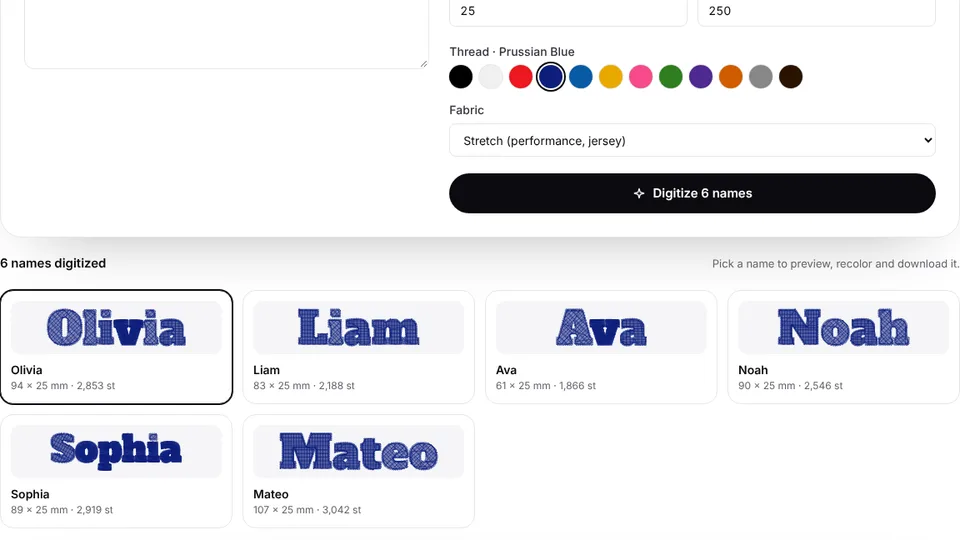
- Make the chest names in one run. Batch name embroidery takes up to 30 names, one per line, and digitizes each in the same font, height and thread. Set the maximum width to 89 mm (3.5 in) and it flags wider names; about 20 mm tall fits most names up to eight letters. Saving the files needs a paid plan.
- Mark every robe from one template printed at true size with the placement template, the same distance below each collar.
- Stitch in passes: every back title, sorted by thread color, then every chest name in the small hoop, so a single-needle machine needs a handful of thread changes, not several per robe.
- Check, press and label: trim the mesh and jump threads, press from the inside with a press cloth and tag each robe with its owner's name.
A back title sews in about 5–15 minutes, slower in metallic. With hooping, a chest name, trimming and pressing, allow about 30–45 minutes a robe, most of a day for a party of eight.
Stitch the bride's robe last. By then the hooping, tension and placement are proven on the bridesmaids' robes.
How far ahead should you start bridesmaid robes?
Start about 6–8 weeks before the robes are handed out, and no later than 4. That's often a shower, a bachelorette or a proposal box well before the wedding, and blanks in matching colors can take a while to arrive:
| When | What to do |
|---|---|
| 6–8 weeks before the hand-out | Agree layout, fonts and colors, collect the list and order the robes plus a spare of each color |
| 5–6 weeks before | Make the files, send a proof of each title with the name list and get written approval |
| 4–5 weeks before | Test-sew on the spare robe |
| 3–4 weeks before | Stitch the bridesmaids' robes, then the bride's |
| 2–3 weeks before | Press, check every name against the list, remake anything wrong and pack |
| 1–2 weeks before | Hand them over, or ship with tracking |
Add a care card: wash cool on a gentle cycle in a mesh bag, hang to dry and press from the inside on a low setting. For a ring pillow, handkerchiefs and other gifts, the embroidered wedding gifts guide has a timeline for the set, and the wedding names maker lays out a names-and-date hoop for the couple.
Practice on a free design
167 ready-to-sew designs in every machine format, free with an account.




How much should you charge for embroidered bridesmaid robes?
Price each robe from the blank, materials, time and packaging, then check the market: personalized satin robes on Etsy start under $15, but many are printed with vinyl, while embroidered robes mostly list at about $25–$55. An example for a satin robe with a back title and chest name, with numbers to swap for your own:
| Cost | Example | Amount |
|---|---|---|
| Blank satin robe | Including a share of the spare | $12.00 |
| Mesh, tear-away and thread | Two placements | $1.00 |
| Your time | List, hooping, stitching, trimming, pressing and packing: 35 minutes at $25 an hour | $14.58 |
| Packaging | Tissue, a bag and a care card | $1.50 |
| Total cost | Before fees and profit | $29.08 |
| Price | $29.08 ÷ (1 − 15% fee allowance − 20% profit) | About $45 |
- Adjust per robe: a few dollars less for a back title only, a little more for metallic thread or a waffle or cotton blank.
- Party sets batch well, so a small discount per robe on six or more still pays.
- Rush orders inside four weeks: charge for them, or say no.
The 15% fee allowance is a placeholder, not any platform's rate. How to sell personalized embroidery covers personalization fields, proofs and returns.